Check out our White Paper Series!
A complete library of helpful advice and survival guides for every aspect of system monitoring and control.
1-800-693-0351
Have a specific question? Ask our team of expert engineers and get a specific answer!
Sign up for the next DPS Factory Training!
Whether you're new to our equipment or you've used it for years, DPS factory training is the best way to get more from your monitoring.
Reserve Your Seat Today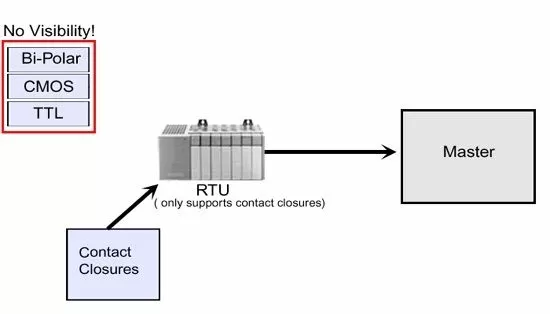
The 4 Most Common Excuses for Not Monitoring CMOS, TTL, -Battery, and Bi-Polar Signals
You can't afford not to monitor a device simply because it doesn't output contact closures. You invested money your equipment, and you should protect your investment with solid monitoring.
How do you effectively gain visibility over all of your devices without busting your budget? You need a device that can convert non-standard signals (TTL, CMOS, -Battery, Bi-Polar) into contact closures. This will allow you to connect currently unmonitored equipment to your existing monitoring system.
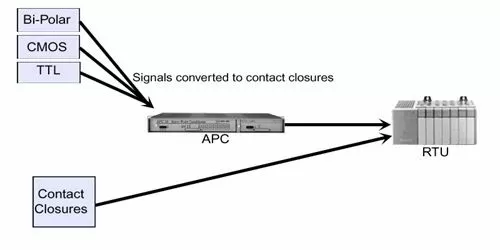
The Alarm Point Conditioner, CMOS, TTL, and Bi-Polar signals by converting them into contact closures that your existing dry-closure RTU can receive. This can all be accomplished without creating a hole in your budget.
After APC Deployment - Complete Visibility of All Site Devices
The Alarm Point Conditioner also has an additional application for those who need to send contact closures to more than one RTU. Typically, this is an issue when departments need to each see the data in their own "system". This is an incredibly useful function at co-location sites, where alarms must often be reported to multiple masters.
With the APC in alarm-point-duplication mode, 18 alarm inputs are duplicated into two identical sets of 18 contact closures. By wiring each set of 18 closures into a separate RTU, duplicate alarms can be sent to separate monitoring systems. As they are relay-isolated, there won't be any negative system interaction. If you attempt to share alarms without this type of technology, you can easily get unexpected current-flow paths.
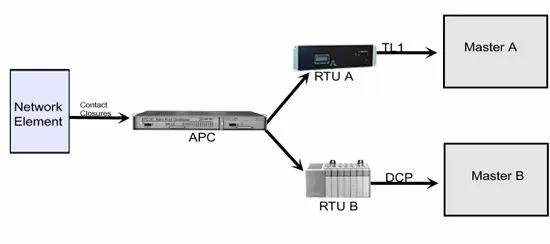
The APC has dual capabilities and offers you two highly valuable functions in a single device. At the flip of a dipswitch, the APC can be configured between alarm-signal-conversion and alarm-point-duplication modes.
There is no excuse for not monitoring your network. The price of efficient monitoring is dwarfed by the revenue it will protect. Invest in high-quality monitoring and enjoy the benefits of heightened network reliability.
The APC can replicate up to 18 alarm points to 2 different RTUs. If you need larger capacity and the capability to bring alarms into more than 2 systems, the Alarm Distribution Shelf (ADS) is your solution.