Download our free Monitoring Fundamentals Tutorial.
An introduction to Monitoring Fundamentals strictly from the perspective of telecom network alarm management.
1-800-693-0351
Have a specific question? Ask our team of expert engineers and get a specific answer!
Sign up for the next DPS Factory Training!
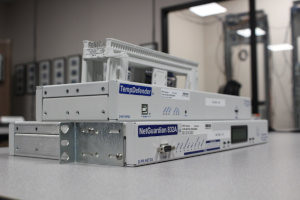
Whether you're new to our equipment or you've used it for years, DPS factory training is the best way to get more from your monitoring.
Reserve Your Seat TodayThe main consequences of power failure are obvious. If commercial power fails at your remote site, and you don't have an emergency power backup supply, the site will go dark. Dark sites mean network downtime, lost revenue, and angry customers who will shift their business to another provider.
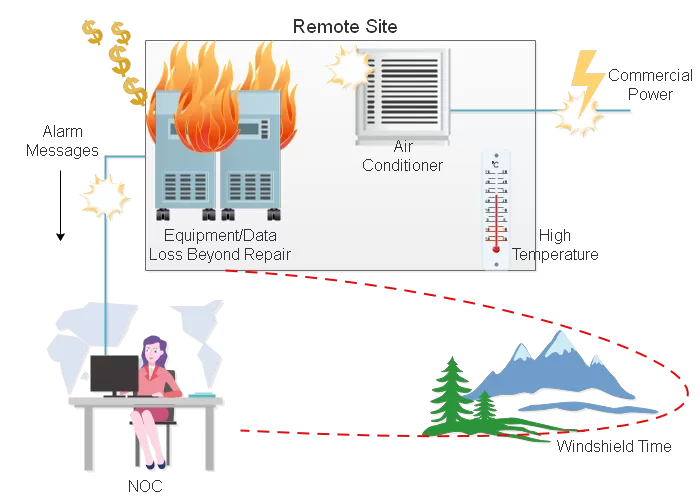
But loss of power also cause long-term damage that isn't so obvious. A complete power loss at a remote site can affect your gear - and your business - even after power is restored.
Here are some of the top hidden damages caused by lost power. Consider these 5 good reasons why you need a bulletproof power monitoring and power backup plan.
You may have backup power for your revenue-generating gear, but do you have backup power for your air conditioning?
A surprising number of telecoms forget about the need for air conditioning in a power outage. They may have a DC battery power plant for revenue-generating gear, but they provide no alternate AC power for air conditioning. Just because gear isn't rack-mounted doesn't mean it's not vital to network operations.
The revenue-generating equipment keeps running - until the rising temperature forces a thermal shutdown. Thermal shutdown from failed air conditioning is, in the long run, a greater expense than a site that simply fails from a power outage. Equipment in thermal shutdown can't be restarted until the temperature returns to normal - long after the power outage is over. This makes recovery time longer and reduces revenue.
Most backup batteries are not designed to be completely drained of electricity. For the long-term working life of the battery, it must be joined to a constant source of recharging power, either commercial or from a working generator.
Batteries that are run all the way down can damaged permanently. Considering the expense of telecom-quality batteries, multiplied by the number of remote sites affected by the outage, this can become a noticeable business expense.
Heat stemming from failed air conditioning will dramatically shorten the useful life of batteries. For example, a lead-acid battery that would last ten years under ordinary conditions will be reduced to only 1 1/4 years if it is consistently operated at temperatures above 122 degrees Fahrenheit.
To ensure that your batteries are always ready to take over in the event that your site loses primary power, they should always be fully monitored. In many cases, battery backups provide their own performance monitoring systems, however, if the backup fails, so do these. Therefore, your battery backup's internal monitoring systems cannot be trusted to notify you when a serious backup-related problem occurs.
You'll need to employ an external backup system. Small Remote Telemetry Units (RTUs) are available specifically to measure battery voltages at relatively little cost.
With a small RTU, you'll set threshold alarms for each individual battery in the backup string. If a voltage goes over or under its desired range, the RTU will set an alarm. If any battery in the string should fall outside its normal range by a percentage you define, the RTU will also set an alarm.
Anytime you have to put a highly paid technician in a truck and send him to a remote site you are losing money. If the problem could have been handled through monitoring and control relays, you're losing money.
Your power loss recovery plan must include an adequate source of backup power, and a means of switching to backup power automatically. You must also be able to monitor the status of your backup power supply, and regularly test whether battery levels are adequate and backup generators are functional.
Unmonitored batteries cause excessive truck rolls, and your likely have more unmonitored batteries than you realize. For example, start-up batteries for generators are typically not monitored. If commercial power fails, and the generator can't start because of a drained starter battery, you'll definitely have to send a maintenance technician. If the battery is unmonitored, you won't know it until you need it. Another way to prevent this is to regularly exercise your backup generators.
T/MonLNX can help keep your power supply in good order. T/Mon's derived alarms feature makes it easy to schedule generator self-tests that happen entirely in the background. You receive an alarm only if the generator test is not performed.
Maintaining your backup power supply will reduce the damage caused by power outages and the need for repairs, keeping your windshield time and truck rolls to the bare minimum.
Your remote power outage monitor also needs a reliable source of backup power. A major service breakdown is no time to lose visibility of your remote sites.
If your remote monitoring gear is offline during a power outage, you'll miss these vital alarms:
Status of backup power supply.
Environmental alarms for overheating, fire, and water damage.
Site security, door, gate, and intrusion alarms.
What all these hidden damages add up to is unnecessary costs. The effects of a power outage are not only on your gear, or on your actions - the true net effect is on your bottom line.
The financial effect of a power outage falls into four categories:
Lost revenue.
Repair of damaged gear.
Replacement of gear damaged beyond repair.
Manpower costs of restoring service.
Unless you have an adequate backup plan, power outages mean increased costs and lost revenue. You owe it to your business to protect yourself with a proactive response to power outages.
11% of all network outages caused by natural disasters.
62% of network downtime caused by natural disasters.
49% of outages are caused by human error.
Telecom repair costs have increased by 133% from 1994-2002.
99.5% network reliability rate is equal to 216 minutes of downtime per month.
99.99% network reliability rate, is equal to 4.5 minutes of downtime per month.
The ratio of how fast a bad reputation spreads to how quickly a good reputation spreads is 24:1.
The average cost of disruption to wireless service, $4.8 million per hour.
Outages are caused mainly by natural disasters or human error.
If you use a good network alarm monitoring system, you can prevent human error and swifly repair damage from natural disasters. This is important, because your reliability percentage can get shredded by even a short outage. Because bad news spreads like wildfire, you have to keep your customers happy by keeping your network online.
The best way to keep your network online is to improve your situational awareness with a better alarm monitoring system.
Sources: 1,2,3, IEEE Computer; 4, U.S. Census Bureau; 5,6,7, Telephony Online; 8, Wireless Review
Related Articles
Whether you're a phone service provider, internet service provider or some other type of telecommunications company, it's your responsibility to ensure that your communication services are always operating correctly...
by Andrew Erickson on December 10, 2019
Synonymous with stability, UPS Battery Backups are renowned for providing seamless uptime to important operations. Nevertheless, the knowledge to troubleshoot potential problems and downtime is far more nuanced. Via...
by Moon Wang on June 28, 2019
An important aspect of using RTUs (remote telemetry units) for monitoring is the collecting and reporting of data from your remote sites. Your monitoring system needs a way to collect this data and report it to you via...
by Andrew Erickson on May 3, 2019
If you have remote telecom sites, HVAC control will always be necessary for you. HVAC (Heating, Ventilation, and Air Conditioning) systems are responsible for keeping your sites at an appropriate temperature, so that your...
by Andrew Erickson on April 3, 2019
Remote temperature monitoring is most commonly used in telecommunication or IT environments where computer equipment must work with high reliability and high visibility for many years. This kind of monitoring protects you from...
by Andrew Erickson on December 3, 2019