A high-quality building access system will enhance the security of your sites.
This guide to will show you how to ensure the safety of your revenue-generating equipment.
1-800-693-0351
Have a specific question? Ask our team of expert engineers and get a specific answer!
Sign up for the next DPS Factory Training!
Whether you're new to our equipment or you've used it for years, DPS factory training is the best way to get more from your monitoring.
Reserve Your Seat TodayDickey Rural Networks (DRN), a regional telecommunications provider, needed a practical way for on-call staff to confirm network status across multiple remote locations. By using the DPS Telecom T/Mon web interface on a smartphone, DRN could quickly verify alarms and keep the network "all green" from almost anywhere.
| Industry | Telecommunications (telecom, Internet, television services) |
|---|---|
| Company | Dickey Rural Networks (DRN) |
| Geography / Coverage | 7 counties in North Dakota and 2 counties in South Dakota; network span of almost 100 square miles |
| Primary Challenge | Maintain on-call awareness and site control for critical equipment across multiple remote sites and outbuildings |
| Solution Deployed | T/Mon master with web interface accessible from a smartphone web browser |
| Key Result | On-call staff could check alarm status and confirm system health from virtually anywhere, not just at home near a phone |
| Products Used | T/Mon platform (web interface) |
Dickey Rural Networks (DRN) has provided telecommunications, Internet, and television services since 1950. Over the years they expanded their portfolio to include local and long distance phone services, custom calling features, voicemail, small and large business telephone systems, special circuits, high-speed and dial-up internet services, personal internet security services, wired and wireless network consulting, web design and hosting, business system software design, and television services.
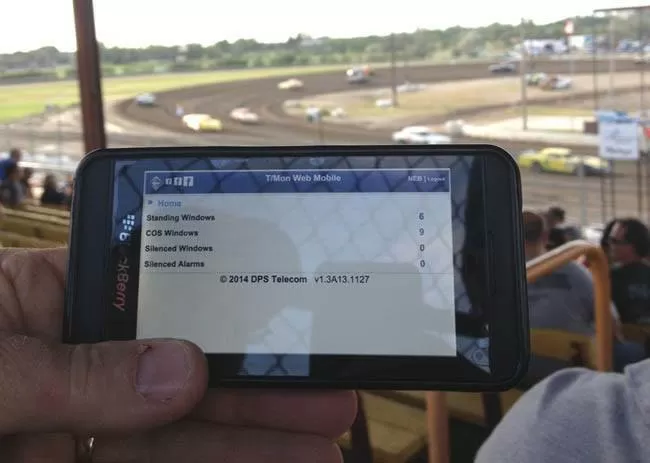
Nolan Baldwin of Dickey Rural Networks uses his iPhone® to check T/Mon's web interface from a stock car race.
"The whole concept is to see little things before they can become big things."
DRN's extensive network spans a wide geographic area of almost 100 square miles. Nolan Baldwin, a Central Office Tech, works with telephone switching equipment and the supporting infrastructure DRN relies on every day.
He deals with gear vital to DRN's daily operations, such as backup generators and server cabinets. With this gear located at different remote sites and outbuildings, Baldwin tracks many access points for personnel and outside vendors. Physical security over DRN's interior and exterior operations is a serious issue, and it is closely tied to fast alarm visibility and clear operational status.
Before smartphone access, being "on call" could mean staying near a phone and waiting for an alert. For organizations with dispersed sites, that limitation can slow down situational awareness when a technician needs to confirm whether a condition is active, cleared, or escalating.
For Baldwin, one key feature of the DPS Telecom T/Mon master was the web interface, which is compatible with his iPhone® smartphone and other smartphones. This allowed him to use a standard mobile web browser to view the alarm status and quickly confirm whether the network was in a normal state.
T/Mon is designed to centralize alarm and status information so technicians can determine what is happening and where it is happening without logging into multiple systems. In deployments like this, the web interface supports practical, real-world workflows by making the same alarm presentation available when staff are away from their desks.
While each organization structures monitoring differently, DPS Telecom typically supports alarm aggregation and visibility across critical infrastructure such as:
When your goal is faster verification and fewer blind spots, DPS Telecom generally recommends pairing centralized alarm management (T/Mon) with the right front-end alarm collection at each site (such as RTUs and SNMP monitoring) as appropriate for your network. In DRN's case, the success highlighted here focuses on the operational value of T/Mon's web interface for mobile access.
"It used to be that, when you were on call, you had to wait at home near a phone," Baldwin said. With T/Mon's web interface available on his smartphone, he could make sure his network was "all green" from just about anywhere, including the stands of a stock car race (as shown in the photo above).
For an on-call technician, that simple ability to check status remotely can reduce uncertainty and speed up the decision to investigate further, dispatch, or continue monitoring. Just as importantly, it can help confirm when an issue has cleared, which supports better handoffs and fewer unnecessary site visits.
T/Mon platform - Central alarm management with web interface for remote visibility
The T/Mon web interface lets authorized users view alarm status and system health using a standard web browser. This supports technicians who need to verify conditions when they are away from the NOC or office.
On-call work often requires quick confirmation: Is an alarm active, cleared, or escalating? Smartphone access can provide that visibility without requiring the technician to return home or log into a workstation.
No. Mobile web access typically complements notification methods by enabling fast verification and context. Many teams use a combination of notifications and a central alarm display for confirmation and follow-up.
Remote locations create more points of failure and more operational dependencies. Centralized alarm management helps teams see the current state across sites in one place, supporting triage and consistent response.
If you need to extend alarm visibility beyond the office - especially for on-call coverage across remote telecom locations - DPS Telecom can help you design an approach using T/Mon and the right site-level monitoring and integration options.
Get a Free Consultation or call 1-800-693-0351 to speak with a DPS Telecom expert about your project.
(The trademark iPhone® is owned by Apple Inc.)
(The trademark BlackBerry® is owned by Research in Motion Limited.)