Check out our White Paper Series!
A complete library of helpful advice and survival guides for every aspect of system monitoring and control.
1-800-693-0351
Have a specific question? Ask our team of expert engineers and get a specific answer!
Sign up for the next DPS Factory Training!
Whether you're new to our equipment or you've used it for years, DPS factory training is the best way to get more from your monitoring.
Reserve Your Seat Today
John Sablatura, network operations technician for Big Bend Telephone.
Big Bend Telephone operates telecommunications infrastructure across the remote Big Bend area of Texas, where some sites can take half a day to reach. To reduce truck rolls driven by unknown conditions and limited alarm visibility, Big Bend deployed DPS Telecom T/Mon LNX with NetGuardian RTUs to standardize monitoring and escalate alarms to the right on-call staff.
| Industry | Telecommunications |
|---|---|
| Company | Big Bend Telephone Company |
| Geography / Coverage | Big Bend area of Texas; large rural territory with very remote sites |
| Primary Challenge | Improve visibility and consistency across remote sites to reduce preventable dispatches and speed troubleshooting |
| Solution Deployed | Centralized alarm management with T/Mon LNX and distributed alarming with NetGuardian RTUs; paging escalation to duty and on-call supervisors |
| Key Result | Greater network visibility, earlier awareness of outages (before customer calls), and better coordination for dispatch and emergency power response |
| Products Used | T/Mon LNX, T/Mon NOC, NetGuardian 864, NetGuardian 216 |
In the late 1950's, Neville Haynes had a vision of providing communications service to people who lived in the vast, isolated Big Bend area of Texas. Big Bend Telephone Company was born.
In 1965, Southwestern Bell Telephone Company granted 2-way EAS to Big Bend Telephone Company. Ten years later, the company filed an application with the FCC for a new 2 GHz microwave system. In 2005, the company diversified by becoming an internet service provider, offering high speed internet to their rural customers.
Big Bend Telephone Company continues to grow and expand with the ever-changing telecommunications industry. They are committed to providing customer service and modern communications technology throughout the farthest reaches of their exchanges.
Distance alone makes rural operations expensive. As network operations technician John Sablatura explained, some Big Bend sites are so remote that a technician leaving at 7:00 might not arrive until noon or 1:00. In those conditions, even a simple misdiagnosis can consume a full day of labor.
But travel time was not the only issue. Big Bend also needed consistency and visibility. When configuration and alarming vary site to site, the NOC cannot confidently guide field technicians, and troubleshooting becomes slow and unpredictable.
"One of the big issues when I was hired was that nothing was consistent," said Sablatura. "You couldn't send a technician and walk them through what needed to be done because you didn't know what the site looked like."
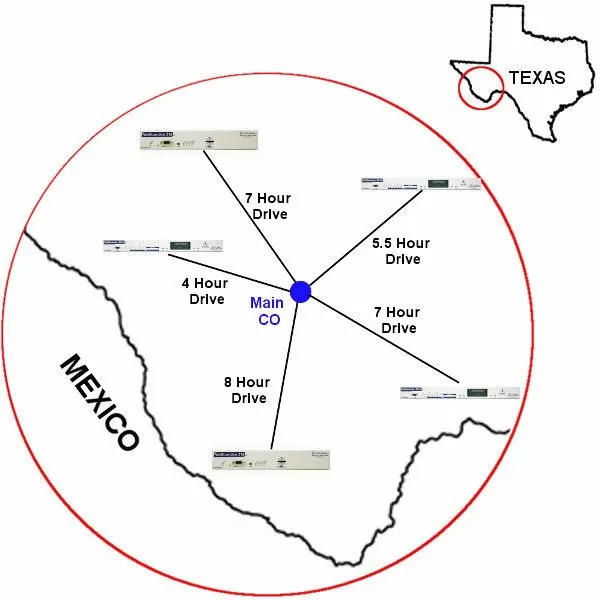
Big Bend Telephone covers a large area. Some of the remote sites are 5 or more hours from their main CO.
Big Bend tried new equipment to streamline their sites and to make things more consistent. While uniformity was gained, functionality was lost during a network transition. "When we upgraded from a [legacy hardware switch] to a [soft switch], we lost a lot of visibility," said Sablatura. "The [legacy switch] simply told you what was wrong. The [soft switch], not so much. You really had to dig to get it."
For a telecom operator, that kind of reduced visibility can lead to reactive operations: learning about issues from customer calls instead of from alarms. Big Bend decided it was time to rebuild their monitoring approach from the ground up.
"We tore it all out. Just completely gutted it and started over," said Sablatura.
Big Bend adopted DPS Telecom monitoring to restore end-to-end visibility and create a consistent alarm workflow for remote locations. They started with a T/Mon NOC and then upgraded to T/Mon LNX to improve monitoring capabilities while keeping day-to-day operations simple for staff.
"When the LNX came out, we didn't have the NOC very long. DPS made us a good deal and we swapped it out and it was simple," said Sablatura. "We just pulled the old one out and put the new one in. And everything worked."
From a technical perspective, this approach follows a proven DPS Telecom pattern:
For organizations managing many unmanned or lightly staffed facilities, DPS Telecom systems like T/Mon LNX are designed to provide that single operational view, while NetGuardian RTUs extend visibility to the edge of the network. This is especially useful when the business goal is to reduce preventable truck rolls and shorten time to restore service.
After installing T/Mon LNX, Big Bend expanded monitoring coverage across the network. "We've gained more visibility. We have equipment that had never been alarmed," said Sablatura. "We had no idea until customers started calling. And now we can see everything."
That improved visibility gave Big Bend the confidence to continue building out their DPS Telecom footprint: "We've got the T/Mon LNX, at our main CO, and then we have a bunch of the 864s and some 216s," said Sablatura. "We have 13 exchanges that all have their own COs so there's one at each one of those and then we have one at each site. That's how we monitor our fiber and stuff coming into us. And then we have remotes in remote sites."
Operationally, Big Bend uses T/Mon to escalate alarms to the right people without waiting for customer reports. "The T/MON will page the duty supervisor with an alarm and he will call one of us to see what's going on," said Sablatura. "If we need to dispatch somebody to the sites to take care of it, it pages the on-call supervisor."
This paging and escalation workflow is a common reason telecom operators select DPS Telecom: it helps ensure alarms trigger a defined response path (duty supervisor, on-call supervisor, and technicians) so field dispatch is intentional and informed, not reactive.
With T/Mon LNX in place, Big Bend reported practical improvements that directly support fewer and better-targeted dispatches:
T/Mon also helped Big Bend protect uptime during emergency conditions by making power problems visible right away. "When the power goes out, it tells us the power is out at those sites," said Sablatura. "The sites that don't have generators permanently, our guys can start taking portable generators to, so the batteries don't die."
For remote telecom infrastructure, this kind of alarm-driven power response can be the difference between a controlled mitigation (deploying portable generators in time) and an extended outage caused by battery depletion. Pairing T/Mon LNX with RTU-based site alarming is a proven way to turn power events into clear, actionable notifications.
With a reliable system in place, Sablatura attended DPS factory training to learn more about T/Mon SNMP capabilities. "SNMP is going to be big for us," said Sablatura. "It is really going to open up our alarming when we get back."
As telecom networks evolve, SNMP alarming becomes increasingly important for bringing visibility back to IP-based equipment that may not provide the same built-in, plain-language status reporting as legacy systems. T/Mon LNX can integrate SNMP alarm and status data alongside traditional site alarms, helping teams unify monitoring across mixed technology generations.
"The equipment is good but the tech support is really what makes it. When we call and get somebody without having to wait or open a ticket to get to somebody," said Sablatura. "And you don't spend a lot of time with the tech support. They know what they're doing."
If your operation includes hard-to-reach telecom sites, DPS Telecom typically recommends a similar design: deploy NetGuardian RTUs at the edge for discrete, analog, and SNMP-based visibility, and use T/Mon LNX at the central office or NOC to drive consistent alarm response and reduce unnecessary dispatch.
These are common questions from telecom operators modernizing remote site monitoring with DPS Telecom.
When alarms identify what failed and where, teams can decide whether a dispatch is required, bring the right parts, and avoid repeat trips. Centralizing alarms in T/Mon LNX and collecting site conditions via NetGuardian RTUs supports that workflow.
Common signals include utility power status, generator status, battery condition (via connected sensors), door alarms, temperature, and equipment alarm contacts. Where supported, SNMP can add IP device status and performance traps into T/Mon.
As networks migrate from legacy hardware to soft-switch and IP infrastructure, many alarms move into software and SNMP. Training and configuration in T/Mon LNX can help translate those events into actionable notifications for operations staff.
DPS Telecom systems are commonly deployed with repeatable alarm templates, clear naming conventions, and escalation rules. That consistency makes it easier for NOC staff to support technicians, even when sites are geographically dispersed.
If you are supporting remote telecom exchanges, COs, or huts and need earlier visibility into site conditions, DPS Telecom can help you design an alarm and escalation strategy around T/Mon and NetGuardian RTUs. Get a Free Consultation or call 1-800-693-0351 to speak with an expert about your project.