Check out our White Paper Series!
A complete library of helpful advice and survival guides for every aspect of system monitoring and control.
1-800-693-0351
Have a specific question? Ask our team of expert engineers and get a specific answer!
Sign up for the next DPS Factory Training!
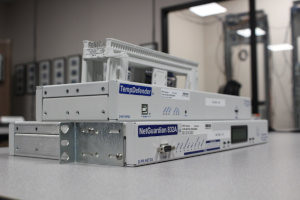
Whether you're new to our equipment or you've used it for years, DPS factory training is the best way to get more from your monitoring.
Reserve Your Seat Today
Fresno VA Hospital needed faster, more centralized visibility into campus security and panic alarms while still auto-dialing for emergency assistance. Using DPS Telecom DPMs (Discrete Point Modules) integrated into a T/Mon SLIM alarm monitoring system, the hospital consolidated alarm points, improved operator awareness, and supported quicker response.
| Industry | Healthcare (Hospital) |
|---|---|
| Company Type | VA hospital and medical campus |
| Geography/Coverage | Fresno, California (campus-wide monitoring) |
| Primary Challenge | Consolidate many distributed security and panic alarm points, reduce response time, and enable status visibility from any PC on the hospital network. |
| Solution Deployed | DPMs interfacing physical contact-closure points to auto-dial notifications, reporting into a centralized T/Mon SLIM for monitoring, history, and web access. |
| Key Result | Centralized alarm monitoring and faster coordination of emergency response with network-accessible visibility and automatic dial-out. |
| Products Used | DPMs (Discrete Point Modules); T/Mon SLIM |
The Fresno VA Hospital prides itself on providing high quality, prompt care to veterans. Supporting that mission requires clinical and support services to work together, including ensuring a secure environment for patients and employees.
Roy Bacon, a biomedical engineering technician responsible for keeping medical equipment sound, is also responsible for the security alarm systems used across the campus.
To prevent unauthorized access to restricted areas and reduce the risk of physical threats, the hospital monitors entrances, exits, windows, and panic circuits throughout the facility. When a door, window, or panic button is activated, the alarm must immediately reach the right responders, including outside emergency assistance such as local law enforcement.
As the number of alarm points grew, Bacon wanted to consolidate the system and improve performance. He also needed authorized users to view the status of any alarm point from any PC on the hospital computer network.
"We decided to put the T/Mon SLIM into place to consolidate all those alarms to make the whole system faster..."To meet these requirements, the Fresno VA Hospital used DPS Telecom DPMs (Discrete Point Modules) as the interface between physical alarm points and the emergency paging system. In this application, the DPMs connect to electrical contact closures from doors, windows, and panic buttons (via wire-wrap blocks), translate those events into alarm points, and automatically place a call for emergency assistance through an in-house PBX and paging server.
As the system expanded, the hospital integrated those DPM alarm points into a centralized DPS Telecom T/Mon alarm monitoring system using a T/Mon SLIM. T/Mon SLIM provides one place to database, monitor, and interpret alarms across the campus, while also supporting automatic dial-out when an alarm is triggered from any DPM on-site.
T/Mon SLIM combined with a custom panic alarm system provides centralized alarm visibility and faster coordination.
From an engineering perspective, this approach helps in three critical ways:
"Panic buttons tied to a contact closure are hidden mostly under a desk or some place isolated and out of view," said Bacon. "When that button is pressed, the alarm sets off and a point is triggered in the DPM which then dials the number."
With patients that require 24/7 monitoring, the hospital depends on fast, accurate alarms. In this application, the system is designed to automatically dial out for help and support emergency team response 24 hours a day.
Over time, Bacon added additional DPMs to meet demand as the panic alarm system grew. "When I came on site about 5 years ago, they already had 3 or 4 DPMs, and now we've increased it to 10," said Bacon. "We'll probably keep going from there, because of the needs of our panic alarm system."
Using the internal web browser, T/Mon SLIM makes it easier to maintain the monitoring database as new devices and points are added. For teams standardizing processes, this kind of centralized alarm management is a common reason hospitals and other mission-critical facilities choose DPS Telecom monitoring solutions.
The VA Hospital panic alarm system provides security for patients and adds support for staff members. "There have been a number of situations where the T/Mon SLIM actually alerted the law enforcement that there was a problem in the area," said Bacon. "They were able to get someone into that situation so no one would get hurt."
"That's one of our primary concerns - that our people are well protected..."Reliable notifications help ensure staff have enough support to handle a situation and minimize potential harm while securing a patient. "That is one of our primary concerns - that our people are well protected," said Bacon. "The T/Mon SLIM has helped to improve that scenario."
Bacon planned to remove monitoring gear from analog telephone lines and move it onto the hospital network for enhanced alarm data transfer and increased web accessibility. "In the next few years, we're probably going to go away from the telephone system interface," said Bacon. "A network setup is ideal, because it gives you the ultimate in terms of speed and reliability," said Bacon.
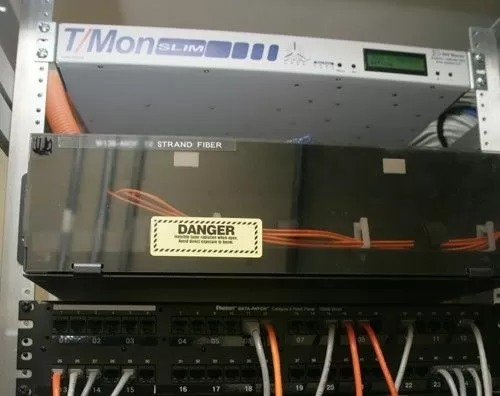
Ethernet connectivity also means technicians can check the status of alarms from anywhere inside the hospital by browsing to T/Mon SLIM. "Being able to see alarms from any terminal is great!" said Bacon. "You can see what an alarm component is doing, upload and find the history of it, and print out a history log."
Bacon also used DPS Telecom onsite turn-up and installation assistance. DPS Engineering Technician Chris Hower worked with Bacon on-site to set up the new T/Mon SLIM with existing DPMs. "He's a great guy to work with, he's very knowledgeable, and he loves DPS."
"That makes me feel good about the product, makes me feel good about the people who serve us, and makes me feel good about the possible relationship down the road..."After implementation, Bacon noted DPS Telecom's commitment to its clients. "When I talk to people at DPS, they say it's a great place to work," said Bacon. "That makes me feel good about the product, makes me feel good about the people who serve us, and makes me feel good about the possible relationship down the road."
If you are modernizing from legacy phone-line interfaces to IP connectivity, DPS Telecom also offers Ethernet and SNMP-capable RTU solutions for alarm transport and site aggregation. Explore the NetGuardian RTU product family to support network-based monitoring architectures.
These are common engineering questions when designing healthcare security and panic alarm monitoring with DPS Telecom products.
A DPM (Discrete Point Module) is used to interface physical dry contacts and other discrete alarm points into an alarm monitoring and notification workflow. Contact closures are common for doors, windows, and panic buttons because they are simple, reliable, and easy to test.
T/Mon SLIM centralizes alarm database, status, and history so authorized staff can interpret events from one place instead of checking multiple devices. In this story, it also supports automated dial-out from any DPM-reported event and provides web-based visibility inside the hospital.
When a panic button or monitored entry point triggers a contact closure, the DPM registers the point and initiates notifications, including dial-out through the PBX/paging server. The alarm is also presented in the central monitoring system so staff can confirm the event, review point descriptions, and coordinate response.
Organizations often migrate off analog lines to improve accessibility and integrate monitoring into existing network operations. For this hospital, network access supports viewing alarms from terminals across the facility and aligns with plans to improve speed and reliability.
Central monitoring systems like T/Mon SLIM support browsing alarm status, retrieving history logs, and printing event history. That helps technicians troubleshoot intermittent issues and document when points changed state.
To receive a price quote or ROI analysis, or to discuss an alarm consolidation project, call DPS at 1-800-693-0351.