Download our free Monitoring Fundamentals Tutorial.
An introduction to Monitoring Fundamentals strictly from the perspective of telecom network alarm management.
1-800-693-0351
Have a specific question? Ask our team of expert engineers and get a specific answer!
Sign up for the next DPS Factory Training!
Whether you're new to our equipment or you've used it for years, DPS factory training is the best way to get more from your monitoring.
Reserve Your Seat TodayNorthwest Communication Cooperative (NCC) supports telecom services across northwest North Dakota and needed a practical way to monitor many dispersed locations for power, environment, and security conditions. By deploying DPS Telecom NetGuardian RTUs with the T/Mon alarm monitoring platform, NCC gained centralized visibility into remote alarms and the ability to manage site access without unnecessary travel.
| Industry | Telecommunications |
|---|---|
| Company | Northwest Communication Cooperative (NCC) |
| Company Type | Member-owned telecom cooperative |
| Geography / Coverage | Northwest North Dakota |
| Operations Footprint | 16 central offices and 25 towers |
| Primary Challenge | Monitor dispersed remote sites for battery voltage, temperature, and controlled building access while reducing travel time to rural locations |
| Solution Deployed | NetGuardian RTUs at remote sites reporting alarms to T/Mon for centralized monitoring and dispatch |
| Key Result | Centralized remote visibility and improved access management, helping technicians avoid unnecessary truck rolls |
| Products Used | NetGuardian RTUs; T/Mon platform |
Northwest Communication Cooperative (NCC) was incorporated in 1951 to provide members in northwest North Dakota with a telephone system. Today, NCC strives to be the premier provider of telecommunication services by providing local telephone service, high speed internet, and cable television. They emphasize competitively-priced service and technical sustainability.
NCC operates out of 16 central offices and 25 towers to provide customers with these services. Each location has its own equipment, and each location must be monitored to protect uptime and maintain consistent service quality.

Kory Olson, a Network Technician at NCC, came to DPS Telecom for Factory Training and shared how NCC uses its DPS monitoring equipment in day-to-day operations.
"We use our NetGuardians and T/Mon for monitoring battery voltage, observing temperatures, and for providing building access."
NCC needed to keep eyes on a large number of remote facilities spread across rural territory. As the network footprint expands beyond a single building, operations teams typically need to monitor:
When sites are far apart, sending a technician to verify a condition can consume hours. NCC noted that one of its most distant towers is 75 miles away and the drive can take over an hour in rural conditions.
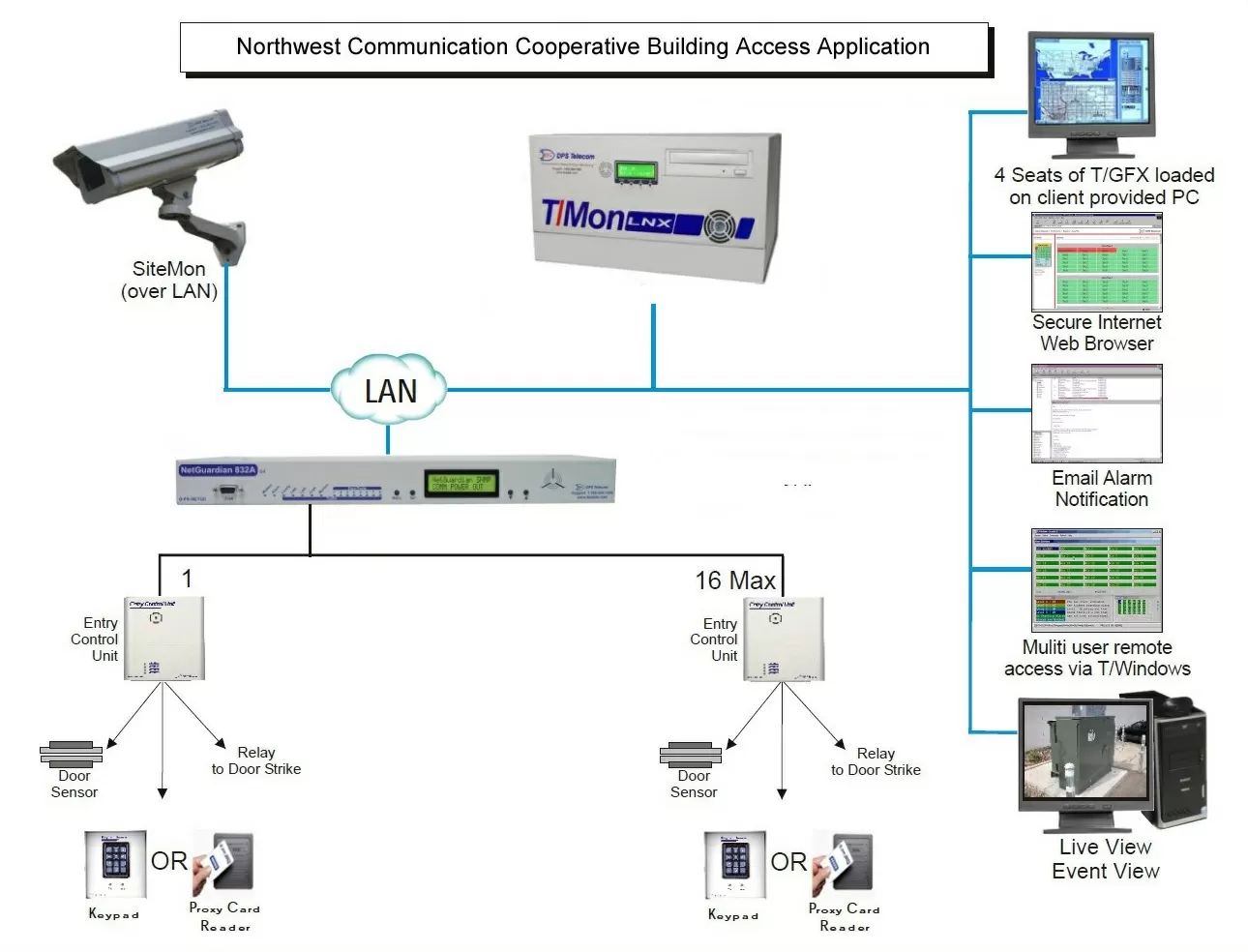
NCC implemented DPS Telecom NetGuardian RTUs at remote sites and used the T/Mon platform to aggregate and present alarms at a central monitoring location. This architecture is a common best practice for telecom operators with many unmanned or lightly staffed facilities: local alarm collection at the site, plus centralized visibility and alarm handling.
In this setup, a NetGuardian RTU functions as an on-site alarm collection and reporting device. Depending on how a site is engineered, RTUs can interface to common telecom facility signals such as analog values (for example, battery and temperature sensors) and discrete status points (for example, door contacts). They can then forward alarm information upstream to an alarm master such as T/Mon using standard monitoring workflows.
Olson and NCC use NetGuardian RTUs in combination with T/Mon to monitor their remote sites. "We use our NetGuardians and T/Mon for monitoring battery voltage, observing temperatures, and for providing building access," explained Olson. "We have expensive equipment and we hardly give out keys to our sites. Now we know it's safe without having to worry about letting someone in who doesn't have a key."
For telecom organizations, remote access control is often paired with alarm monitoring so that operations staff can correlate security events with network conditions. With an RTU-based approach, access-related alarms can be treated like any other operational event: logged, displayed centrally, and used to trigger a defined response.
"It's a great system because if a vendor or contractor needs to get into one of our sites, we can give them access without having anybody show up to let them in."
With the NetGuardians and T/Mon, NCC is able to monitor towers and remote sites from a single location. "Our furthest tower is 75 miles out so we cover some distance," explained Olson. "It takes about an hour and fifteen minutes to get out there and it's all pretty rural."
Centralized alarm management is most valuable when it helps technicians make a decision before rolling a truck: what is happening, where it is happening, and whether it requires immediate dispatch. In practical terms, this means operations staff can prioritize site visits and avoid driving long distances just to confirm a normal condition.
DPS gear saves NCC valuable time and helps technicians like Olson avoid expensive truck rolls to remote sites. "It's a great system because if a vendor or contractor needs to get into one of our sites, we can give them access without having anybody show up to let them in," said Olson. "And if the power is out we call in the FFA in the middle of the night instead of checking the site ourselves."
"Our monitoring is used pretty heavily on the telephone side but not so much on the Ethernet side," he explained. "In the future we'll probably add more DPS monitoring to the Ethernet side."
Olson attended DPS Factory Training in California to learn additional options available with the NetGuardian and T/Mon. "Training has been really good," said Kory. "It's interesting to learn more about the equipment- you can use it for monitoring a lot of stuff."
As networks evolve, teams often want to extend monitoring coverage to additional systems and interfaces. With an RTU-and-alarm-master approach, organizations can typically expand points of visibility over time (for example, adding new sensors, new alarm points, or additional sites) while keeping the same central monitoring workflow in T/Mon.
By using the NetGuardian and T/Mon, Northwest Communications has options for customizing their systems in the future. "It would be nice to set up even more monitoring with the NetGuardian and T/Mon," said Olson. "Our monitoring is used pretty heavily on the telephone side but not so much on the Ethernet side," he explained. "In the future we'll probably add more DPS monitoring to the Ethernet side."
For telecom cooperatives and rural providers, this type of deployment supports consistent operational practices: define alarm points at the site, bring those alarms into T/Mon, and standardize how alarms are acknowledged and acted on.
If your organization is building a similar distributed monitoring architecture, DPS Telecom can help you map alarm points, define escalation workflows, and choose the right NetGuardian configuration for each site.
These questions come up frequently for telecom teams designing monitoring for central offices, towers, and other unmanned sites.
An RTU (remote telemetry unit) collects local alarm and sensor data at the site and reports it to a central system. In NCC's case, NetGuardian RTUs are used with T/Mon so technicians can see conditions without driving to each location.
Battery and temperature trends can indicate developing facility problems that can lead to service impact. Monitoring these points helps operators catch issues earlier and prioritize corrective action.
When alarms are visible in one place, staff can verify the site condition remotely, determine whether a visit is required, and decide what parts or support are needed before dispatching a technician.
Many organizations combine access-related points with the rest of their alarm monitoring so access events are visible and managed in the same operational workflow. NCC specifically cited using DPS gear for providing building access.
Teams often start with facility and legacy telecom alarms, then expand to additional areas as requirements mature. NCC noted that future monitoring may be expanded more on the Ethernet side.
Many urgent quote requests start with an earlier "do nothing" decision that becomes an after-hours outage. A right-sized monitoring plan can help you catch facility issues sooner and reduce unnecessary travel.
Call us and speak with an expert about your sites and alarm points. We can email a detailed quote with a custom application drawing and include a summary of business benefits you can use to justify your project budget.
Call 1-800-693-0351 now for your quote
(or send us a quick online message instead)
Get a Free Consultation on your remote site monitoring and alarm management project.