Download our free Monitoring Fundamentals Tutorial.
An introduction to Monitoring Fundamentals strictly from the perspective of telecom network alarm management.
1-800-693-0351
Have a specific question? Ask our team of expert engineers and get a specific answer!
Sign up for the next DPS Factory Training!
Whether you're new to our equipment or you've used it for years, DPS factory training is the best way to get more from your monitoring.
Reserve Your Seat TodayRT Communications, a telecommunications provider serving Wyoming and small regions of Montana and South Dakota, deployed redundant T/Mon LNX master stations with NetGuardian RTUs to detect network and facility alarms early and prevent service disruptions.
| Industry | Telecommunications (regional service provider) |
|---|---|
| Company Type | Telecommunications provider formed through Range Telephone Cooperative's Board of Trustees |
| Geography / Coverage | Wyoming, plus small regions of Montana and South Dakota |
| Primary Challenge | Prevent service disruptions by detecting power and network events quickly (including missing nodes and change-of-state alarms) |
| Solution Deployed | Redundant T/Mon LNX master stations integrated with NetGuardian RTUs for centralized alarm monitoring and change-of-state visibility |
| Key Result | Earlier awareness of major disruptions (including an event affecting 500+ customers), reducing the risk of extended after-hours outages |
| Products Used | T/Mon LNX; NetGuardian RTUs |
RT Communications was created in 1993 through the vision of Range Telephone Cooperative's Board of Trustees to provide the latest in telecommunications services to the residents of Wyoming. Now, RT Communications serves approximately 12,400 subscribers in Wyoming, as well as small regions of Montana and South Dakota.
Services offered by RT today include high speed internet service, secure online data storage, antivirus/spyware applications, local and long distance voice service, custom calling features, voice mail, conferencing service, interconnection and special circuits, business and residential telephone systems, bundled services options, and communications interoperability systems.

Brian Mitchell and Marty Palmer are both Central Office Technicians for RT Communications. They attended Factory Training at DPS Telecom Headquarters in Fresno, CA, and shared how their T/Mon and NetGuardian systems help protect their network.
Network uptime is a day-to-day requirement for service providers. For a telecom operator, power events, communication losses, and equipment state changes can quickly become customer-impacting outages if technicians do not have clear visibility after hours.
RT Communications needed a monitoring approach that would quickly surface network abnormalities (like missing nodes) and facility events (like power disruptions), then route actionable alarms to the right people.
"There have been quite a few instances where noticing change-of-state alarms have prevented service disruptions"
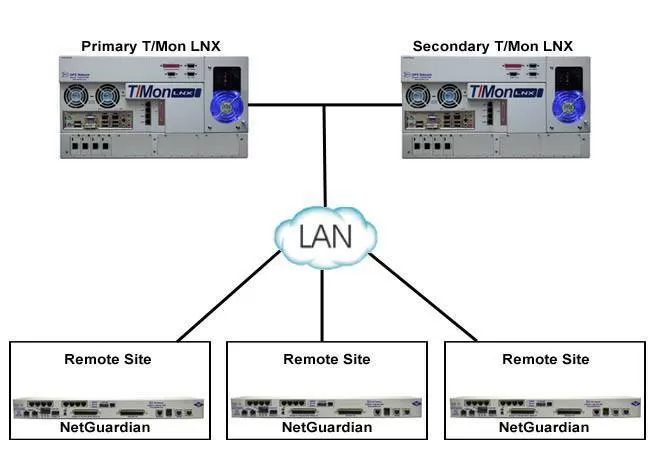
RT Communications deployed redundant T/Mon LNX master stations and NetGuardian RTUs to consolidate alarms and highlight abnormal conditions before they become extended outages. In practical terms:
For service providers who want the same style of visibility, DPS Telecom typically recommends pairing NetGuardian RTUs with T/Mon LNX so operations teams can standardize alarm collection, escalation, and reporting across sites and network elements.
One night, when Mitchell was leaving the office, he noticed an alarm from their T/Mon indicating there were a lot of missing nodes, pointing to a major power disruption. Without that visibility, many RT Communications customers could have gone without service all night long.
"There were 500+ customers that were being affected," said Mitchell. "This alarm kept us on top of that."
In operational terms, this is the value of centralized alarm management: change-of-state events and communication-loss conditions are elevated immediately, instead of being discovered later by customer calls. RT Communications reports that this was not a one-time event, noting additional instances where change-of-state alarms helped prevent service disruptions.
DPS Telecom Factory Training and 7x24 tech support helped RT Communications build confidence using their monitoring tools and get more value from their deployment.
"Tech support has been very responsive. With most other companies, you'll email them and 3 days later get a response, but with you guys it's really quick - I usually just email you guys because it's so fast."
Whenever Mitchell had a question or needed assistance monitoring the network, he turned to DPS Telecom support and documentation. "Your tech support and how-to guides have been really beneficial," he said.
"I hardly knew anything about this equipment...I was taught well here."
Mitchell had about a year's worth of experience working with their T/Mon system, while Palmer had virtually no experience. They both came to Factory Training to learn more about using their T/Mon. "I love Factory Training," said Mitchell. "I'm really going to be able to use this stuff when I get back."
"I hardly knew anything about this equipment when we started," said Palmer. "I was taught really well here."
If you are standardizing monitoring across multiple sites, DPS Telecom typically recommends architecting NetGuardian RTUs for consistent alarm inputs and integrating them into T/Mon LNX for escalation workflows and consolidated visibility.
A change-of-state alarm indicates a discrete input changed (for example, a contact closure opening/closing). In telecom environments, these points often represent power, environmental, access, or equipment status conditions that should be addressed quickly.
"Missing nodes" typically indicates communication loss to monitored devices or sites. That can be a symptom of power failure, transport interruption, or upstream network issues, and it is often an early indicator of customer impact.
NetGuardian RTUs collect alarms at remote sites, while T/Mon LNX consolidates and presents alarms for operators. Together, they support a practical workflow: detect, notify, investigate, and resolve.
Redundancy in the alarm master layer can help keep monitoring available during maintenance windows or unexpected failures, improving the chance that critical alarms still reach the right staff.
If you need earlier visibility into power events, communication losses, and change-of-state alarms across your telecom network, DPS Telecom can help you design a monitoring architecture using T/Mon LNX and NetGuardian RTUs.
Get a Free Consultation or call 1-800-693-0351 to speak with a DPS Telecom expert about your project.