Download our free Monitoring Fundamentals Tutorial.
An introduction to Monitoring Fundamentals strictly from the perspective of telecom network alarm management.
1-800-693-0351
Have a specific question? Ask our team of expert engineers and get a specific answer!
Sign up for the next DPS Factory Training!
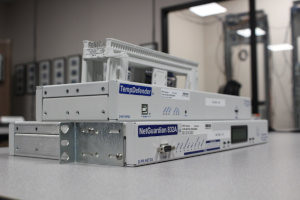
Whether you're new to our equipment or you've used it for years, DPS factory training is the best way to get more from your monitoring.
Reserve Your Seat TodayU.S. Cellular needed reliable remote monitoring and control for a propane generator-powered cell site located more than 100 miles from the nearest technician, with only T1 transport available and no LAN access. By deploying a DPS Telecom NetGuardian 216T RTU with a Rochester Propane Sensor, the team gained remote visibility, automatic alerting, and generator control to reduce unnecessary site visits and speed response to problems.
| Industry | Wireless telecommunications |
|---|---|
| Company | U.S. Cellular (wireless service provider with 5.9 million customers) |
| Role | Cell-site technician (Kurt Klein) |
| Site Conditions | Propane generator-powered cell site over 100 miles away; 3 to 4 hours travel time; can be snowed in |
| Primary Challenge | Maintain uptime and visibility without frequent truck rolls; no LAN access; required native T1 support and analog monitoring |
| Solution Deployed | NetGuardian 216T RTU with a Rochester Propane Sensor; paging and SNMP alarming; remote web-based status and control |
| Key Result | Remote generator management and fuel visibility, automated notifications, and reduced need for routine site visits |
| Products Used | NetGuardian 216T; Rochester Propane Sensor |
Kurt Klein is a cell-site technician for U.S. Cellular. He is responsible for keeping remote cell sites operational, including locations that are difficult and time-consuming to reach.
"I wanted to be able to remotely control and reset the generators, and I wanted to be able to monitor everything I possibly could."
Klein monitored a propane generator-powered cell site more than 100 miles from his base of operations. Travel time to the site made fast restoration difficult. As Klein noted, "It's takes about three to four hours to get there, and it gets snowed in sometimes."
Without effective remote monitoring, one way to reduce the risk of an outage was to run redundant generators continuously. But that approach increased fuel consumption and still did not provide timely failure reporting or eliminate regular truck rolls. U.S. Cellular needed a way to prevent outages and shorten return-to-service times without sending a technician to the site for every status check.
There was also a key connectivity constraint: the cell site did not have LAN access. Klein needed an RTU that supported the site's T1 transport natively while still delivering the analog monitoring needed to keep close track of generator operation and propane fuel levels.
U.S. Cellular selected the DPS Telecom NetGuardian 216T along with a Rochester Propane Sensor to monitor and manage the site. This approach provided both the remote telemetry needed for maintenance decisions and the remote control needed to respond to problems quickly.
"I have the 216T programmed to page me if there's a problem, and we send SNMP alarms to our network master."
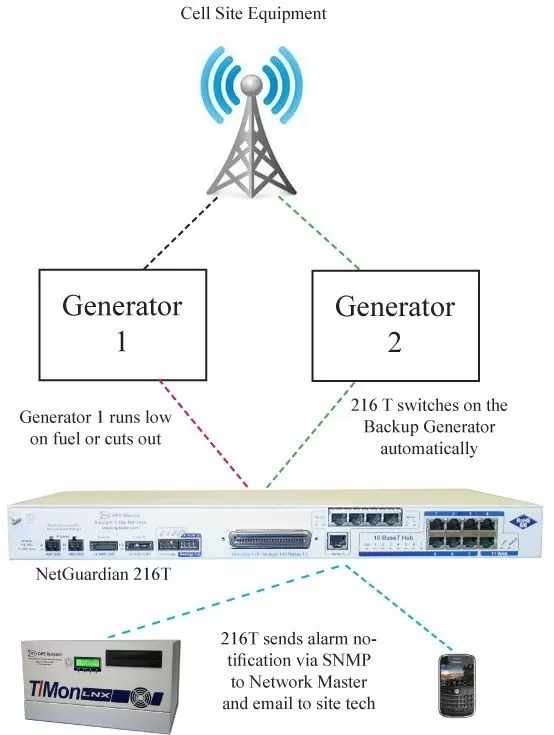
With the propane sensor and the 216T, Klein could set the backup generator to come on only when needed: if the primary generator failed or when fuel reached a critical threshold. The NetGuardian 216T also supported the site's T1 transport, which removed the need for additional networking equipment at the site. As Klein put it, "I liked that I didn't need a separate router to use it."
For telecom operators facing similar constraints (remote sites, long travel times, and limited WAN options), DPS Telecom NetGuardian RTUs are designed to bring discrete and analog telemetry, alarm notifications, and control outputs into a single platform that can communicate upstream via standard protocols such as SNMP.
Visibility without Staring at a Terminal
With the NetGuardian, Klein could stay aware of site conditions without waiting for an outage or scheduling routine truck rolls. The unit was configured for paging on problems and for SNMP alarm reporting to a network master. In addition, the 216T web interface provided a practical day-to-day tool for checking fuel gauges, verifying generator status, and operating control relays to switch generators and other equipment on or off.
In many cell-site deployments, this combination of capabilities is the core value of an RTU: it collects alarms and measurements (such as fuel level), turns them into actionable notifications, and provides safe remote control points so technicians can attempt resets or switchovers before driving hours to the site. NetGuardian RTUs are commonly used for this kind of work because they combine alarm inputs, analog monitoring, and relay control in a single device built for remote infrastructure environments.
Klein also set up multiple notification paths for additional coverage and peace of mind, reducing the need for frequent visits to the site.
Beyond technician alerting, the notification strategy was extended to fuel logistics. As Klein explained, "Actually, I have it setup to email the propane company when the generators get low, so they just go out and fill them up for us."
With the NetGuardian 216T and Rochester Propane Sensor in place, U.S. Cellular gained:
NetGuardian RTUs - Includes models like the NetGuardian 216T used for discrete/analog monitoring, notifications, and control at remote sites.
Some sites do not have Ethernet/LAN access available for monitoring equipment. An RTU that supports the available transport lets operators collect alarms and telemetry without installing additional network devices.
Typical points include generator running and fail status, transfer switch state, battery condition, and analog readings like fuel level. In this case, propane level monitoring was handled using a Rochester Propane Sensor tied into the RTU.
Paging or email can reach on-call staff quickly, while SNMP traps can feed a network master or NOC system for centralized visibility and escalation. Klein used paging for direct notification and SNMP alarms to the network master.
Relay outputs enable remote actions such as switching between generators or turning equipment on and off. This can restore service or stabilize the site before a technician can travel to the location.
If you are managing remote telecom sites with generator power, limited connectivity, or long travel times, DPS Telecom can help you choose the right NetGuardian configuration for the alarms, analog telemetry, and control points you need.
Get a Free Consultation or call 1-800-693-0351 to speak with a DPS Telecom expert about your project.