Check out our White Paper Series!
A complete library of helpful advice and survival guides for every aspect of system monitoring and control.
1-800-693-0351
Have a specific question? Ask our team of expert engineers and get a specific answer!
Sign up for the next DPS Factory Training!
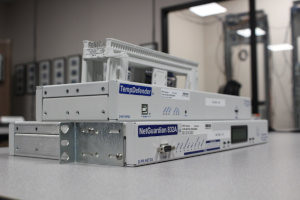
Whether you're new to our equipment or you've used it for years, DPS factory training is the best way to get more from your monitoring.
Reserve Your Seat TodayWhen you think about threats to your telecom network, what comes to mind?
Power failure and equipment alarms are to be expected. But there's another danger - quiet, invisible, and often ignored - that's just as destructive: humidity.
At unmanned remote sites, environmental conditions can silently destroy your most valuable revenue-generating equipment. If you're not monitoring humidity correctly, you could be days - or even weeks - behind a problem that's already costing you real money.
Humidity is a big deal. Let's review the common solutions that fail and how a complete monitoring system can protect your network before it's too late.
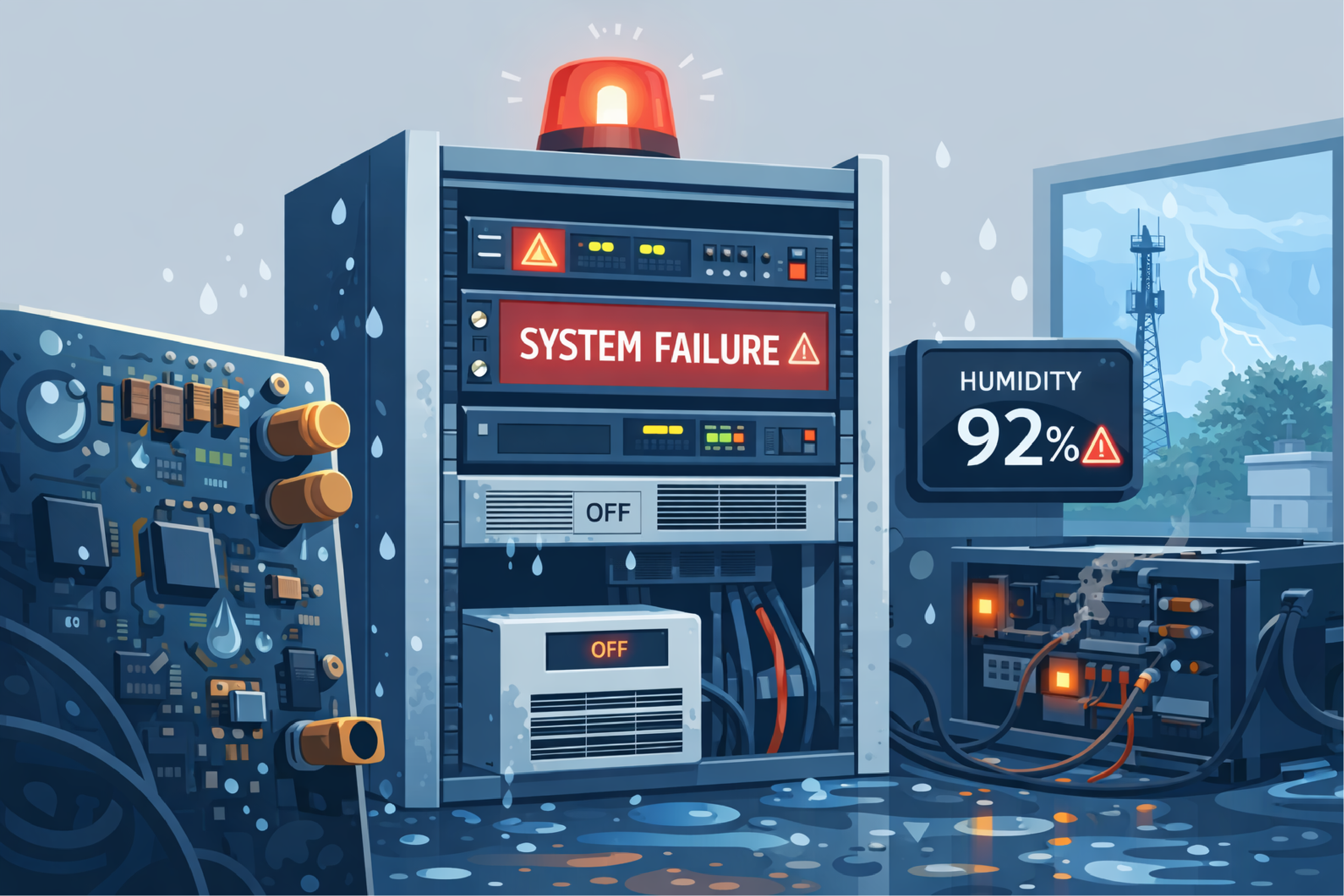
Humidity doesn't crash into your site like a lightning strike. It seeps in slowly - quietly corroding your PCBs, shorting your connectors, and damaging your HVAC and telecom gear from the inside out.
During our work with our clients, we see more than you'd think:
You just lost equipment, time, and/or revenue. And the worst part is it was 100% preventable.
Many network operators think they're covered because they installed a humidity sensor or two years ago. Unfortunately, not all sensors - and definitely not all monitoring strategies - are created equal.
There are two main types of humidity monitoring approaches:
These sensors act like basic thermostats (except that they monitor humidity). You start by setting a high limit, maybe 60% RH. When that threshold is crossed, the sensor sends a contact-closure alarm.
It's simple, cheap, and feels like the monitoring checkbox is "checked".
But the problem is if the humidity goes from 61% to 100%, all you get is a single "high humidity" alarm. There's no nuance, no escalation, and no real understanding of how severe the situation is.
You don't know:
That's a lot of missing context for a problem that can lead to a customer-affecting outage.
Analog sensors give you live, real-time data. You don't just get an "alarm/no alarm" status. You get the actual humidity value, second by second.
This opens the door to multi-threshold alerting, like:
You can now escalate responses based on the severity and speed of the problem.
Even better, analog sensors let you track rate-of-change when connected to the right RTU. If humidity suddenly spikes 10% in 30 minutes, that tells you something's actively going wrong.
That's real insight - and it's what your remote sites need to stay protected.
Most analog humidity sensors require +12VDC to operate.
Telecom environments, though, almost always use -48VDC power.
This is why smart humidity monitoring includes an RTU that can convert -48VDC to +12VDC or that supports simple bus-powered sensors, keeping your sensors online during commercial outages (when even a simple AC transformer would be without power).
At DPS Telecom, our NetGuardian G6 platform is designed for exactly this challenge. You get consistent power, even during blackouts, so there are no gaps or guessing.
Humidity isn't just an inside-the-box problem.
Outdoor humidity can spike and sneak into your shelter the moment your HVAC goes down. If you're only watching internal conditions, you might miss the warning signs.
For a complete picture, we recommend monitoring humidity:
This 3-point strategy gives you environmental context. You'll know if a humidity spike is due to equipment failure or just extreme outdoor conditions. Plus, you'll know how fast it's escalating.
Remember the "bus-powered" option I mentioned earlier? One of the smartest upgrades you can make to your humidity monitoring system is to use D-Wire sensors from DPS Telecom.
These sensors are:
That means you eliminate complex wiring, power adapters, and surprises.
Instead, you're left with clean, clear environmental data that you can actually use to protect your site.
You can have the best sensors in the world, but if you don't have the right RTU to process the data, you're not getting the value.
That's where the NetGuardian G6 Series is helpful.
It's not just a remote telemetry unit. It's a total site monitoring platform.
Whether you're deploying in a harsh desert climate (low humidity and wide temperature swings must be monitored), coastal humidity, or frigid mountain sites, G6 NetGuardian RTUs are rugged enough to handle it.
Collecting alarms from dozens - or even hundreds - of RTUs across your network can quickly become unmanageable.
That's why serious operators pair their RTUs with a T/Mon Master Station.
T/Mon gives you a single dashboard for every environmental alarm, from every site, in real time.
With T/Mon, you get:
It doesn't just show you what's wrong. It shows you where and helps you automate who should respond.
Now that's real visibility.
There are dozens of companies out there selling sensors and boxes. But there's a reason telcos, utilities, railroads, and public safety agencies choose DPS:
We're not a sensor company dabbling in monitoring. We're a monitoring company that builds solutions - humidity, temperature, intrusion, power, and beyond. That led us to also build our own sensors, but we obviously also support any third-party sensor that can give us a contact closure or voltage/current output.
Not monitoring humidity is like driving blindfolded. It might work for a bit - but when it fails, it fails big.
Once moisture gets into your electronics, there's no going back. You'll face:
When you compare those costs to a reliable humidity monitoring setup, the ROI is obvious.
It's time to stop playing environmental roulette with your remote sites.
With D-Wire sensors, NetGuardian G6 RTUs, and a T/Mon Master Station, you'll finally get the visibility you need to protect your network, your budget, and your reputation.
Call 1-800-693-0351
Or email: sales@dpstele.com
Let's build a humidity monitoring system that actually works - and keeps working when other systems fail and you need it most.

Andrew Erickson
Andrew Erickson is an Application Engineer at DPS Telecom, a manufacturer of semi-custom remote alarm monitoring systems based in Fresno, California. Andrew brings more than 19 years of experience building site monitoring solutions, developing intuitive user interfaces and documentation, and opt...