Check out our White Paper Series!
A complete library of helpful advice and survival guides for every aspect of system monitoring and control.
1-800-693-0351
Have a specific question? Ask our team of expert engineers and get a specific answer!
Sign up for the next DPS Factory Training!
Whether you're new to our equipment or you've used it for years, DPS factory training is the best way to get more from your monitoring.
Reserve Your Seat TodayA major subway system operator needed to replace legacy audio selection and distribution panels that could allow a single stuck push-to-talk (PTT) radio to suppress systemwide communications. DPS Telecom developed the NetGuardian ADP, adding timeout-based lockout logic, web-based control, and monitoring to protect radio availability.
| Industry | Public transit (subway) |
|---|---|
| Company Type | Major subway system operator (transit authority) |
| Primary Challenge | Legacy priority-based audio selection panels lacked remote control and had rigid logic that could allow a stuck carrier to jam communications for extended periods |
| Solution Deployed | Custom NetGuardian ADP audio selection and distribution panel with stuck-carrier timeout lockout, user-selectable restore options, and a web interface for configuration and analysis |
| Key Result | Reduced risk of systemwide communications suppression by automatically blocking excessive continuous transmission and enabling remote restoration and troubleshooting |
| Implementation Timeframe | Field trials in September 2018, November 2018, and February 2019; endurance testing through March 2020; rollout planning in 2020 |
| Products Used | NetGuardian ADP; T/Mon platform; NetGuardian RTUs (existing monitoring environment referenced by the client) |
DPS Telecom has supported this subway system for decades with remote monitoring and alarm management. The transit authority is among the most prolific users of NetGuardian RTU devices and T/Mon master stations, and that operational familiarity helped accelerate requirements definition for a new audio selection and distribution panel.
The legacy equipment in question is conceptually similar to analog comparators (sometimes called voter comparators), but the subway system selected channels by priority rather than receiver voting. The decision was not based on choosing the best-quality receiver output; instead, predefined priority logic determined which channel audio would be distributed.
The subway operator wanted to replace older audio selection and distribution panels that were functional at a basic level but lacked the intelligence and remote manageability expected in modern communications infrastructure. The existing panels also had several hardware and configuration constraints that complicated operations and maintenance.
Like many infrastructure systems, replacement was difficult to justify while the equipment continued to operate. Ultimately, a specific operational incident provided the urgency to modernize the panel logic.
In 2017, a police officer began a shift by inserting a handheld PTT radio into its holster, but the radio was inserted at the wrong angle and the push-to-talk button was pinned down. The result was a constant transmission from an unknown location that was not easy to quickly locate.
Because the existing audio selection and distribution panels used rigid built-in logic and police traffic carried the highest priority, the stuck transmission overrode other communications, including central rail controllers responsible for managing train flow. The subway system was effectively suppressed by an unintentional radio jamming event until the radio battery drained hours later, and operations relied on makeshift communications including consumer-grade cell phones.
With two decades of prior collaboration and existing DPS monitoring infrastructure in place, the transit authority asked DPS to develop a solution that could prevent a future stuck-carrier scenario while maintaining the core functional behavior of the legacy audio selection panel. The project goal was a modern replacement panel with substantially more intelligence, better serviceability, and remote management.
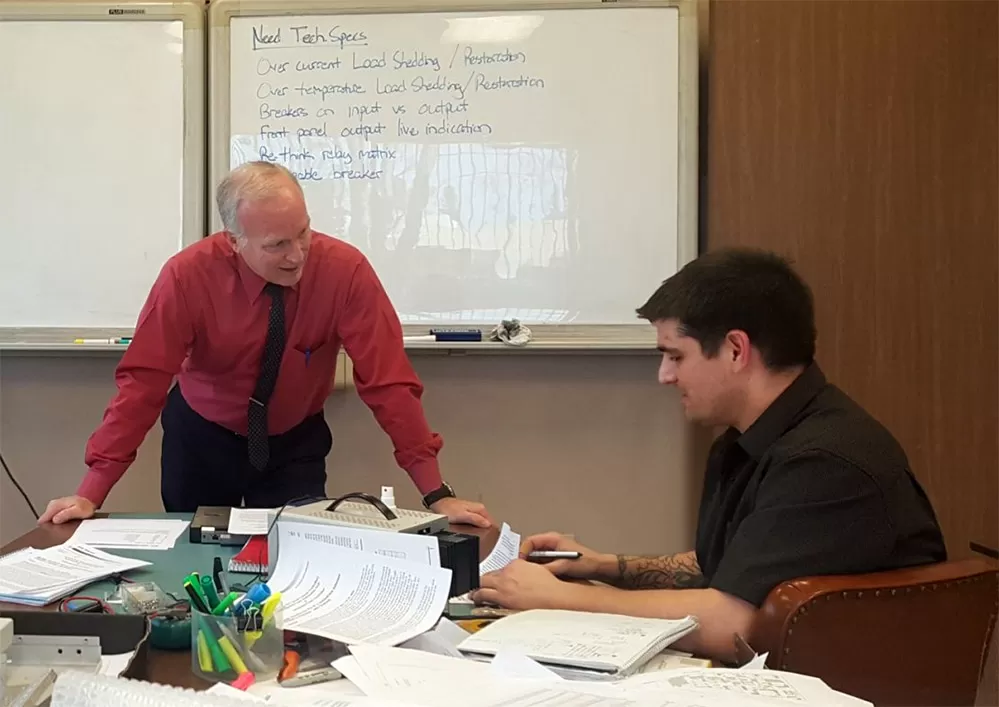
The first design priority was preventing a single continuously transmitting channel from suppressing the rest of the network. Working with subway representatives, DPS implemented a user-definable timeout: if a channel continuously broadcasts beyond the configured duration, the channel is locked out.
Because operational policies differ between agencies (and even between departments), DPS provided two restoration behaviors selectable in the web interface.
Under the manual option, a channel (for example, a police radio channel) is suppressed after the configured continuous carrier duration (such as 60 seconds). A central administrative team can then log into the web interface and manually restore that channel to service after the incident has ended.
This approach prioritizes overall radio availability and prevents repeated suppression, but it can also block a high-priority channel until staff intervene. For that reason, an automatic restoration option was also implemented.
Under the automatic option, a blocked channel can return to service after a defined period of silence. For example, once blocked after 60 seconds of continuous transmission, the channel could be unblocked after another silence period such as five continuous seconds without a 2175 Hz guard tone.
Beyond stuck-carrier mitigation, the project addressed the subway system's broader list of operational issues: overheating and serviceability of power supplies, limited prioritization, screwdriver-only level adjustments, and lack of remote monitoring and control. The design also avoided digital converters and used modern analog design practices to manage analog audio while preserving audio quality.
For organizations that need end-to-end visibility into remote facilities, DPS recommends pairing purpose-built devices like the NetGuardian ADP with NetGuardian RTUs for discrete/analog alarming and network reporting, and using a centralized alarm master such as the T/Mon platform to consolidate, display, and retain alarm history.
Because the panel was designed for a critical, real-world radio network, the deployment process included three onsite field trials, followed by long-term pre-deployment endurance testing. Each trial informed firmware and hardware revisions, including serviceability changes and new troubleshooting features.
After building an initial prototype of the new "NetGuardian ADP," DPS engineers traveled from DPS headquarters in California to the subway engineers' simulation lab for a week of testing.
 The first-revision NetGuardian ADP front panel included status LEDs and an LCD to reflect input and output state at all times.
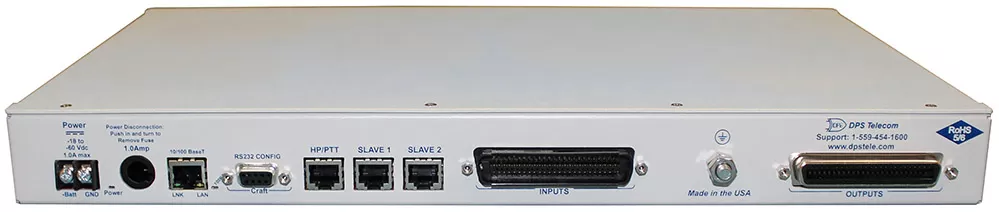 The first-revision back panel was designed to mimic the legacy unit's port placement to simplify replacement by installation teams.
Early testing highlighted additional needs that had not been fully captured at the outset. A major lesson was the client's preference for dual hot-swappable power supplies to address concerns created by prior experiences with unreliable power. While DPS hardware is designed for high reliability, the client wanted both redundancy and the ability to quickly replace a power module if needed.
Testing also surfaced practical realities of the subway network, including smaller signal-to-noise ratios on some longer lines. That led to planning for the ability to tune comparator outputs at levels appropriate for the amount of wire being driven.
After two months and another circuit-board revision, DPS returned for a second week of testing. The hardware improvements included dual hot-swappable power input cards and a change from screw-down terminals to pluggable power connectors to reduce service time.
 Revision 2 added dual hot-swappable power supply cards and updated the indicator LEDs to RGB for clearer state representation.
 Revision 2 retained the same overall back-panel layout while updating connectors and fuses to match the design the client preferred from the NetGuardian 832A RTU.
The updated firmware introduced several capabilities requested by the client and validated during testing:
To support troubleshooting on noisy audio lines, DPS also added a web-interface oscilloscope function called the "Analysis Scope" for deeper visibility into audio levels and behavior during commissioning and investigation.
The third field trial focused on finalizing usability details, confirming default settings aligned with the client's expectations, and validating final hardware and firmware behavior in the client environment.
To reduce future dependence on separate documentation, DPS added embedded guidance directly into the web interface. Notes were placed on relevant pages to help users understand operation and configuration without needing to reference a manual.
One of the largest functional additions at this stage was Auto-Tune, designed to eliminate guesswork and reduce manual level tuning. Early algorithm approaches emphasized smooth adaptation, but the final solution used a direct method: a 0-255 reference voltage lookup table that translated measured input signal strength (dB) into a step level on the digital potentiometer controlling gain.
With this approach, Auto-Tune could adjust quickly (on the order of milliseconds) on each radio broadcast. Users also retained the option to disable Auto-Tune when manual control was preferred.
The table below was prepared during development to document major differences and relevant similarities between the legacy panel and the new solution.
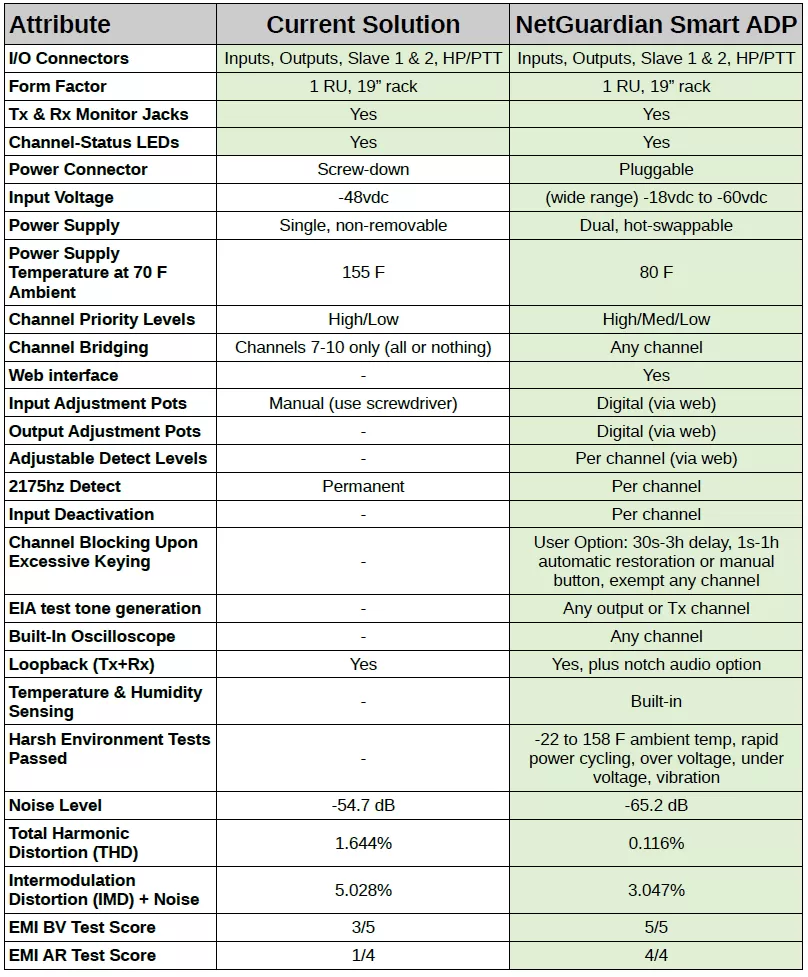
A detailed comparison table was prepared for the end user during development to document changes between the legacy panel and the NetGuardian ADP.
Before scaling to a full rollout (planned at well over 100 units), the transit authority and DPS conducted extended endurance testing. A total of 11 units were deployed, with some operating in labs and the rest in real use within the communications network.
The NetGuardian ADP units maintained performance logging that was occasionally exported for review. For centralized alarming and long-term retention, the subway system used a deployed T/Mon master station configured to poll each ADP roughly every 30 seconds. Alarm conditions were logged indefinitely on T/Mon redundant hard disks.
The year of endurance testing went well, with no hardware failures reported and only a small set of firmware and interface refinements identified for future updates:
Following field trials and endurance testing, DPS and the client prepared for a full rollout of the NetGuardian ADP to remote receiver sites. While broader events in 2020 impacted many organizations, critical infrastructure and public service agencies continued operations, and the project advanced with final firmware adjustments and internal funding planning.
The client cited the value of long-term experience with DPS devices. Established performance of NetGuardian RTUs and centralized T/Mon alarming helped reduce perceived risk for decision-makers evaluating a large deployment.
These questions reflect common engineering and operations considerations for public transit, public safety radio, and other priority-based analog audio distribution environments.
A voter comparator (receiver voting) selects audio based on signal quality metrics, choosing the receiver with the best reception. In this deployment, audio selection was driven by priority logic, where specific channels can override others regardless of received quality.
A stuck carrier occurs when a radio transmits continuously due to a fault or a pinned push-to-talk button. In systems where that channel is high priority, the continuous transmission can suppress other communications until it stops or the channel is explicitly blocked.
Manual restoration maximizes protection against repeated suppression by requiring staff to re-enable a channel after an incident. Automatic restoration can reduce operational burden by returning the channel to service after a defined silent interval. Providing both allows policies to match the agency's operational risk tolerance.
Embedded devices typically have limited onboard storage. A centralized system such as the T/Mon platform can poll frequently, generate notifications, and retain history on redundant storage for long-term audit and troubleshooting.
When the goal is full remote-site visibility, DPS commonly pairs specialty communications devices with NetGuardian RTUs for power, environment, and discrete alarm collection, and then forwards all conditions to T/Mon for centralized display, escalation, and reporting.
If you need to prevent priority-based audio selection from becoming a single point of failure, or if you need a modern replacement for legacy comparators or audio distribution panels with remote management, DPS Telecom can help. Get a Free Consultation or call 1-800-693-0351 to speak with an expert about your project.
If your requirements go beyond standard products, DPS can also evaluate custom engineering options built on proven monitoring and control design practices.

Andrew Erickson
Andrew Erickson is an Application Engineer at DPS Telecom, a manufacturer of semi-custom remote alarm monitoring systems based in Fresno, California. Andrew brings more than 19 years of experience building site monitoring solutions, developing intuitive user interfaces and documentation, and opt...