Check out our White Paper Series!
A complete library of helpful advice and survival guides for every aspect of system monitoring and control.
1-800-693-0351
Have a specific question? Ask our team of expert engineers and get a specific answer!
Sign up for the next DPS Factory Training!
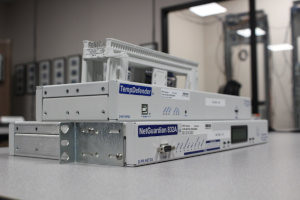
Whether you're new to our equipment or you've used it for years, DPS factory training is the best way to get more from your monitoring.
Reserve Your Seat TodayAny utility with remote telecom infrastructure knows that monitoring isn't optional.
You can't afford to "hope for the best" when a network switch locks up or a critical alarm input goes dark. Still, the reality for many telecom teams is that their current tools aren't reliable enough, and they're forced into frustrating workarounds just to keep things going.
That's exactly what happened to one DPS client - a major utility managing hundreds of microwave towers and substations across a sprawling region. From RTUs that failed right out of the box, to the inability to troubleshoot devices without a long site visit, they had hit a breaking point.
Here, I'll walk you through:
Let's begin.
This client had deployed over 50 RTUs at their microwave tower sites. These rack-mounted RTUs collected critical alarms and were hardwired into their tower infrastructure using standardized 25-pin Amphenol connectors.
Over time, the team started noticing alarming patterns:
Tech support got involved. Screenshots were sent, console ports were connected, and ultimately, devices were sent in for RMA.
Unfortunately, they had no spares left. That meant every failed RTU put them in crisis mode.
Even basic troubleshooting was a chore since they didn't have an AC adapter to power the RTUs in the office. Instead, they had to drive to a live site, unplug a working unit, and test the questionable one there.
"I spent more on gas than I would've on one of those adapters," the client admitted.
This was more than just annoying. It was expensive, risky, and unsustainable.
The client had also started exploring remote power control, especially for substations where routers, firewalls, fiber devices, and cellular modems sometimes needed a manual reboot.
They began evaluating commercial PDUs, but the more they explored, the more the shortcomings piled up:
If the fiber link went down, there was no way to reach the PDU through the backup cellular path. The site was effectively offline.
Many sites were DC-powered for battery backup, especially those under NERC SIP compliance. The commercial PDUs they explored couldn't run on 125VDC, which meant adding power conversion gear or accepting outage risk.
Their field devices - including hardened switches, firewalls, and radios - often didn't have AC-style power cords. Rewiring every one of those just to use a PDU wasn't appealing.
After researching these off-the-shelf options, it was clear they were too limited, too rigid, and too risky for real-world utility environments.
During conversation with DPS, the client laid out a vision for what they really needed: something simple, something that worked.
The client described their ideal device as offering:
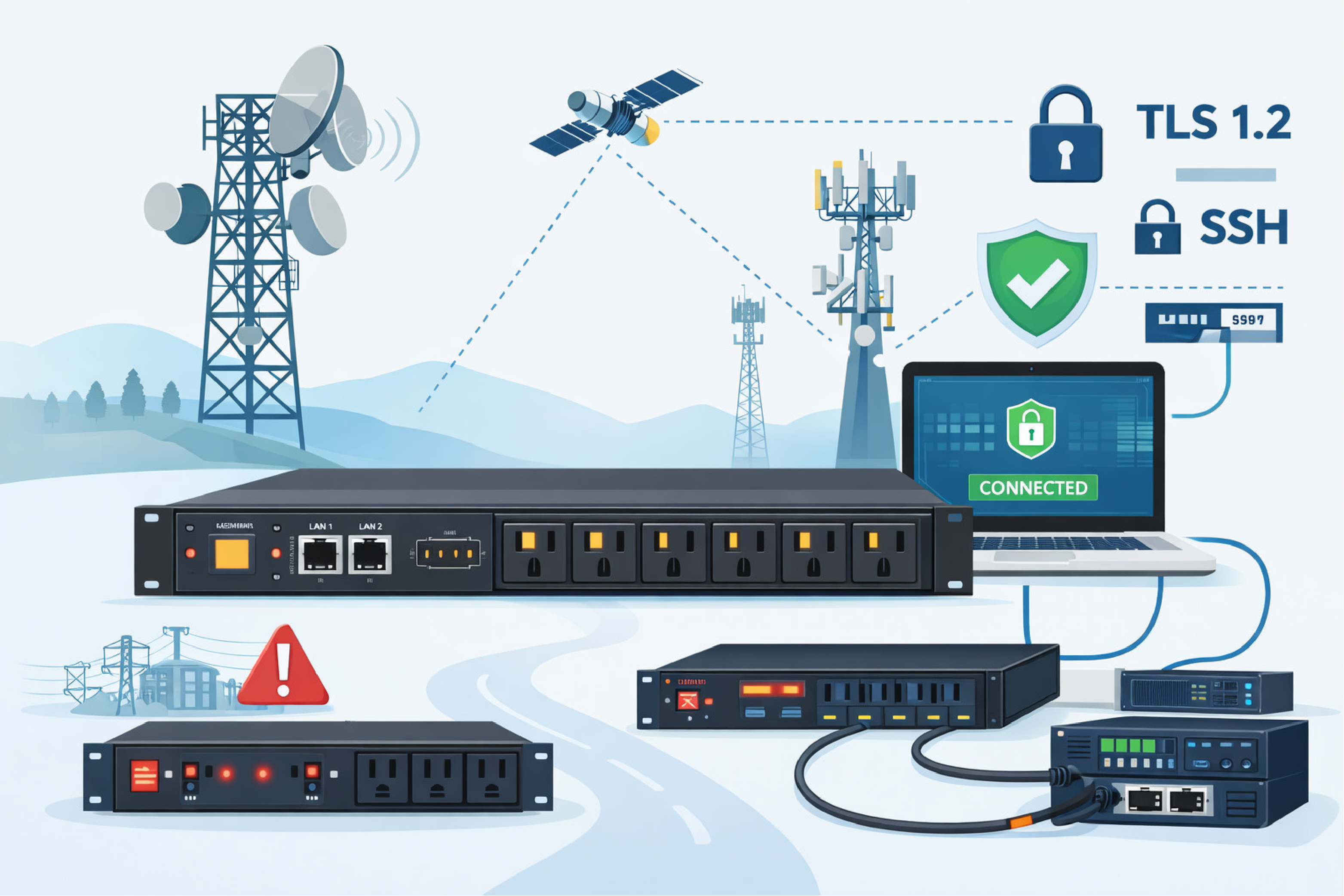
If the primary path (fiber) goes down, they can still access the device via the backup path (cellular VPN). They needed true path redundancy.
Their substations are battery-backed with 125VDC power. The PDU had to run natively on 125VDC - without any converters, no exceptions.
The client was interested in at least 6 AC outlets for rebooting mission-critical gear. This includes firewalls, switches, fiber multiplexers, radios, and cellular failovers.
Since most of their substations had standard telecom racks, rack-mount design was essential.
For outward-facing sites and their future protection, TLS 1.2 and SSH were required. That meant moving to the G6 platform.
The client didn't want a science project. They wanted something that just worked. And it had to be cost-effective enough to scale across 100+ sites.
At DPS, we don't just ship boxes. We listen, adapt, and build exactly what you need.
That's why we developed a custom PDU on the G6 platform, tailored to this client's utility telecom environment.
And we're not stopping there.
Since this would be built on the G6 hardware platform, future capabilities - like REST API support, SNMPv3 enhancements, and onboard automation - are ready when needed.
If you haven't heard of our G6 RTU/PDU platform yet, here's a quick rundown:
We created G6 because NERC CIP rules were tightening - and our clients demanded hardened security. However, security wasn't the only win.
With G6, we now have a unified "model number" structure, where G6 means consistent firmware, UI, and protocols - across HVAC controllers, RTUs, PDUs, and more.
If this solution sounds like something you could use, you're not alone.
At DPS, our threshold to make your dream device into a COTS (Commercial Off-The-Shelf) reality is simple: a commitment of 11+ units. That's all it takes to:
"If we can get 11 of these, and they work, I'd roll them out across 100+ substations," the client told us.
That's exactly what we love to hear.
Once we validate the build, the device becomes a standard part of the DPS catalog. From there, you can order 1, 10, or 100 units - whatever you need.
Remember that power issue? The one that forced the client to drive to towers just to plug in and test RTUs?
We immediately quoted them a wall adapter, pre-wired with the right barrel connector.
The solution was simple, yet able to solve the problem. It also saves gas, time, and headaches.
We include these in our own training lab for exactly this reason.
This client's experience is a textbook case of what sets DPS apart:
If you're a utility, telco, railway, or any organization managing remote infrastructure, odds are you're facing similar problems:
You're not alone on your project - and you don't have to settle for hardware that doesn't quite fit.
Let's design something that works.
Call us at: 1-800-622-3314
Email: sales@dpstele.com
You'll speak to someone who's built these systems for decades. We'll walk you through your needs, your environment, and your existing gear. And if we don't already make what you need, we'll start building.
At DPS, "custom" doesn't have to mean expensive. It means you get what actually works, which is the only type of purchase you should ever want to justify anyway.

Andrew Erickson
Andrew Erickson is an Application Engineer at DPS Telecom, a manufacturer of semi-custom remote alarm monitoring systems based in Fresno, California. Andrew brings more than 19 years of experience building site monitoring solutions, developing intuitive user interfaces and documentation, and opt...