Check out our White Paper Series!
A complete library of helpful advice and survival guides for every aspect of system monitoring and control.
1-800-693-0351
Have a specific question? Ask our team of expert engineers and get a specific answer!
Sign up for the next DPS Factory Training!
Whether you're new to our equipment or you've used it for years, DPS factory training is the best way to get more from your monitoring.
Reserve Your Seat Today
Kuwait National Petroleum Company (KNPC) operates large-scale oil refining and gas liquefaction services where dependable communications are essential to day-to-day operations. After an avoidable remote-site power event went undetected, KNPC deployed a dual-redundant T/Mon SLIM alarm monitoring system with NetGuardian RTUs to improve visibility and notification for critical telecom and network assets.
| Industry | Oil refining and gas liquefaction |
|---|---|
| Company Type | National petroleum company and refinery operator |
| Geography / Coverage | Kuwait, with nine remote sites |
| Primary Challenge | Unmanned remote-site power/rectifier failure went unnoticed until batteries were fully drained |
| Solution Deployed | Dual-redundant alarm monitoring with T/Mon SLIM masters and NetGuardian RTUs collecting power, battery, network, and environmental alarms |
| Key Result | Faster awareness of remote-site issues, centralized desktop monitoring, and added resilience through redundant masters |
| Products Used | T/Mon SLIM, NetGuardian 832A RTU, 48-point digital expansion units, 16-port analog expansion units (future interest: SiteCAM) |
KNPC is one of the largest refineries in the world and a major distributor of petroleum products in Kuwait and internationally. Because communications systems support coordination across refinery operations and remote facilities, KNPC required a monitoring approach that could quickly surface problems at unmanned sites and route actionable alarms to telecom staff.
A remote-site rectifier failure exposed a gap in visibility. The site was unmanned, and when the power failed the batteries drained completely before staff realized what had happened.
"Normally the power doesn't fail here. It was an unmanned station, the power failed and all the batteries were drained completely."
Even when a power event is manageable in principle, it becomes operationally risky if the team cannot see it in time. KNPC needed a solution that could:
KNPC selected a DPS Telecom monitoring architecture built around two core layers:
This approach is designed to turn raw points (contact closures, voltage thresholds, network reachability checks, and environmental sensors) into actionable alarms that can be acknowledged, tracked, and escalated to the right technicians.
A Monitoring System That Meets the Exact Needs of the Network...
To monitor their nine remote sites, KNPC deployed a dual-redundant system configuration of T/Mon SLIMs. By deploying redundant masters, KNPC has a backup in the event they ever encounter a hardware failure.
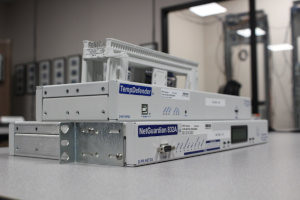
KNPC also deployed nine NetGuardian 832A RTUs at their remote sites to collect alarms from important telecom equipment. At sites where additional alarm capacity was needed, KNPC installed 48-point digital expansion units and 16-port analog expansion units.
For teams building similar systems, DPS Telecom recommends this same layered design: use a hardened RTU (such as a NetGuardian) to interface with site equipment, then use a T/Mon master to consolidate alarms, apply notification policies, and provide operator workflows that scale as more sites are added.
Ravipati Seetaramaiah, a KNPC engineer, traveled from Kuwait to DPS Telecom headquarters in Fresno, CA to attend a DPS Factory Training Event. During his week of training, Seetaramaiah learned about monitoring strategies and equipment to support KNPC's telecom operations and assets.
As part of his evaluation process, Seetaramaiah used DPS Telecom technical resources to refine what KNPC needed in a monitoring system.
"The training, company culture and the people - everything was excellent."
Factory Training Provides the Knowledge Needed to Evaluate Monitoring Options...
Seetaramaiah's research brought him and his colleagues to DPS headquarters in Fresno, CA to train directly with DPS engineers and technicians while developing a custom-fit monitoring solution for KNPC.
After training, KNPC's telecom staff spent additional time reviewing the features of DPS monitoring equipment. This gave the team a stronger technical base for day-to-day monitoring operations and for expanding the system over time.
KNPC monitors multiple classes of alarms across telecom power and network infrastructure. This combination helps operators quickly distinguish between a facility power problem, a DC plant issue, and an IP network outage.
This is a common best practice DPS Telecom designs for: combine contact closures and analog thresholds from site equipment with IP polling and reachability checks, then use T/Mon SLIM to standardize how alarms are displayed and delivered to staff.
With T/Mon SLIM masters and NetGuardian RTUs in place, KNPC gained centralized visibility into remote-site conditions that previously could go unnoticed. The dual-redundant master configuration also provided added resilience for alarm monitoring operations.
Most importantly, KNPC shifted from learning about remote-site issues after the fact to receiving alarms as conditions occur, supporting faster response and better protection for critical telecom operations supporting refinery activities.
Future Plans for Even Better Monitoring...
KNPC expects to broaden its relationship with DPS as their network expands and their monitoring needs grow. Seetaramaiah hopes to someday complement their system by installing video monitoring equipment.
He was particularly interested in using DPS SiteCAM video monitoring equipment to enhance repair and maintenance operations. With surveillance cameras at remote sites, central office operators can see on-site technicians and provide specific instructions, helping accelerate repairs and minimize downtime.
"We are looking forward to increased association with DPS, and to expanding our equipment," said Seetaramaiah. "We expect everything to go smoothly for us."
These questions come up often when refinery and industrial telecom teams evaluate DPS Telecom monitoring for remote and unmanned sites.
At minimum, monitor AC fail, rectifier/charger alarms, DC bus voltage, and battery-related thresholds. A NetGuardian RTU is commonly used to bring these discrete and analog points into one place for alarm reporting to T/Mon SLIM.
Redundancy helps maintain alarm visibility if a master device experiences a hardware failure. KNPC used a dual-redundant T/Mon SLIM configuration so monitoring can continue during a failure scenario.
Ping alarms can confirm reachability for servers and switches, while discrete and analog alarms cover power, breaker status, and voltage conditions. Combining both gives a clearer picture of whether an outage is caused by power, network, or device-level issues.
In addition to on-screen monitoring in the NOC, alarm systems can escalate notifications via call-out to pager/mobile so staff learn about problems as they occur.
Call 1-800-693-0351 to receive a:
Or Get a Free Consultation to discuss how DPS Telecom can design T/Mon and NetGuardian monitoring for your remote sites.