Check out our White Paper Series!
A complete library of helpful advice and survival guides for every aspect of system monitoring and control.
1-800-693-0351
Have a specific question? Ask our team of expert engineers and get a specific answer!
Sign up for the next DPS Factory Training!
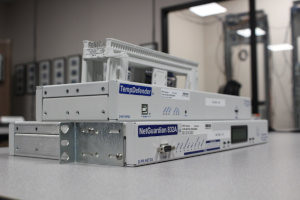
Whether you're new to our equipment or you've used it for years, DPS factory training is the best way to get more from your monitoring.
Reserve Your Seat Today
You're standing in a remote equipment shelter, looking at a unit that has watched over the site longer than anyone on your current team has worked here. Maybe an overnight outage caught everyone off guard because nobody saw it coming. Maybe the manufacturer sent an end-of-life notice. Maybe your carrier just gave you 90 days before the copper line at that site goes dark. Whatever the trigger, you're now on the hook to pick the next remote telemetry unit (RTU), and the wrong choice is expensive to live with for the next two decades.
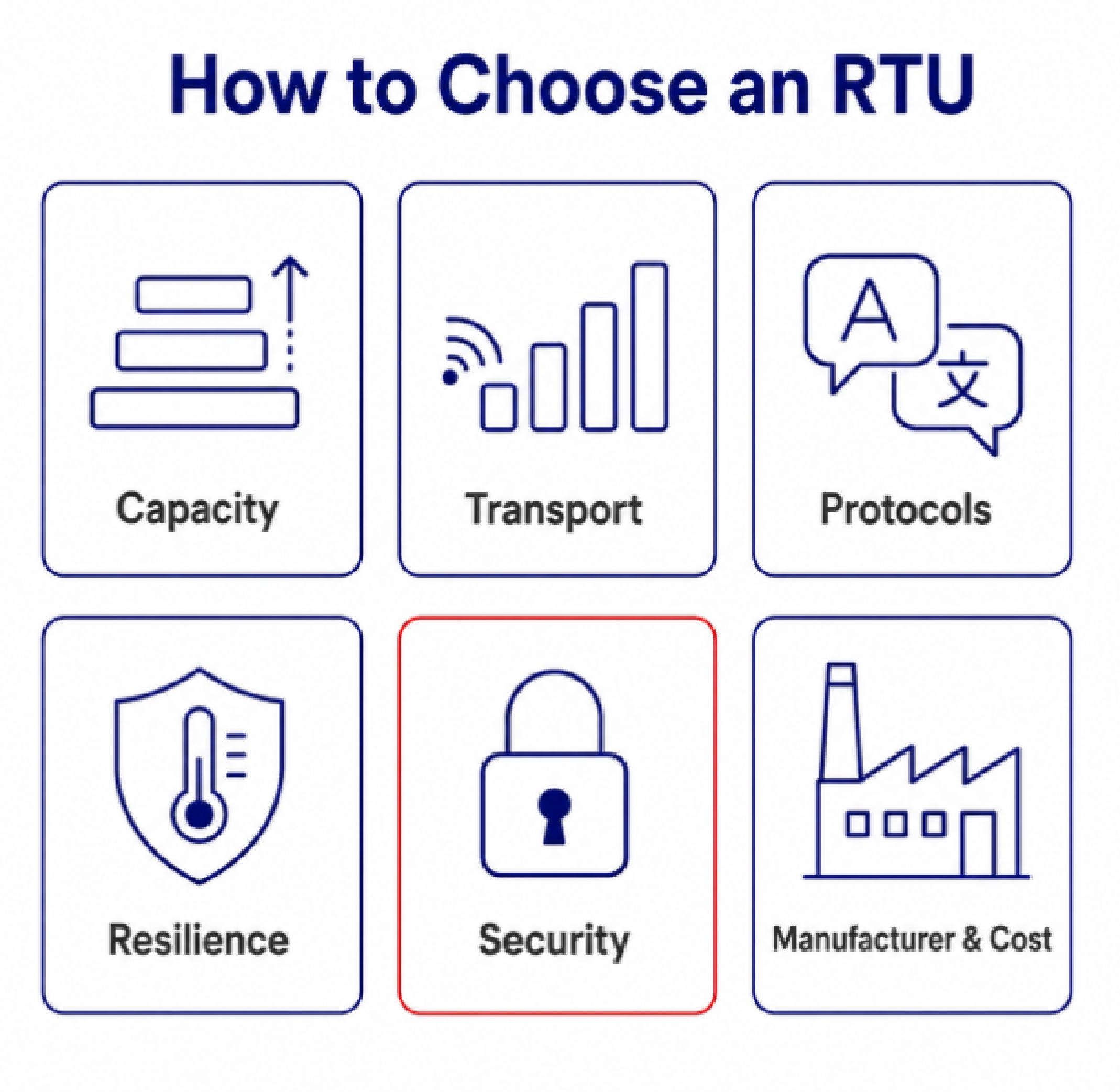
Choosing the best RTU comes down to matching six things to your actual sites: how much you need to monitor (with room to grow), the transport already running at each location, the protocols your equipment speaks, how rough the environment gets, your security requirements, and the company that builds and stands behind the box. The smartest buyers then prove that fit with a hands-on trial before they commit, instead of guessing from a datasheet. At DPS Telecom, we've built more than 172,800 monitoring devices for over 1,500 companies since 1986, and plenty of those RTUs are still running in the field 20 years later. So the rest of this guide reflects what tends to separate a good fit from a costly mismatch.
Here's the framework in short. Work each criterion against your real sites:
An RTU is your eyes and ears at an unmanned site. In our book, 100% Uptime, we describe it as the boots on the ground at each location. It collects alarms and readings and reports them back, so your team knows what's happening without driving out to look. Sizing one starts with counting three kinds of monitoring points, because most field equipment maps to one of them:
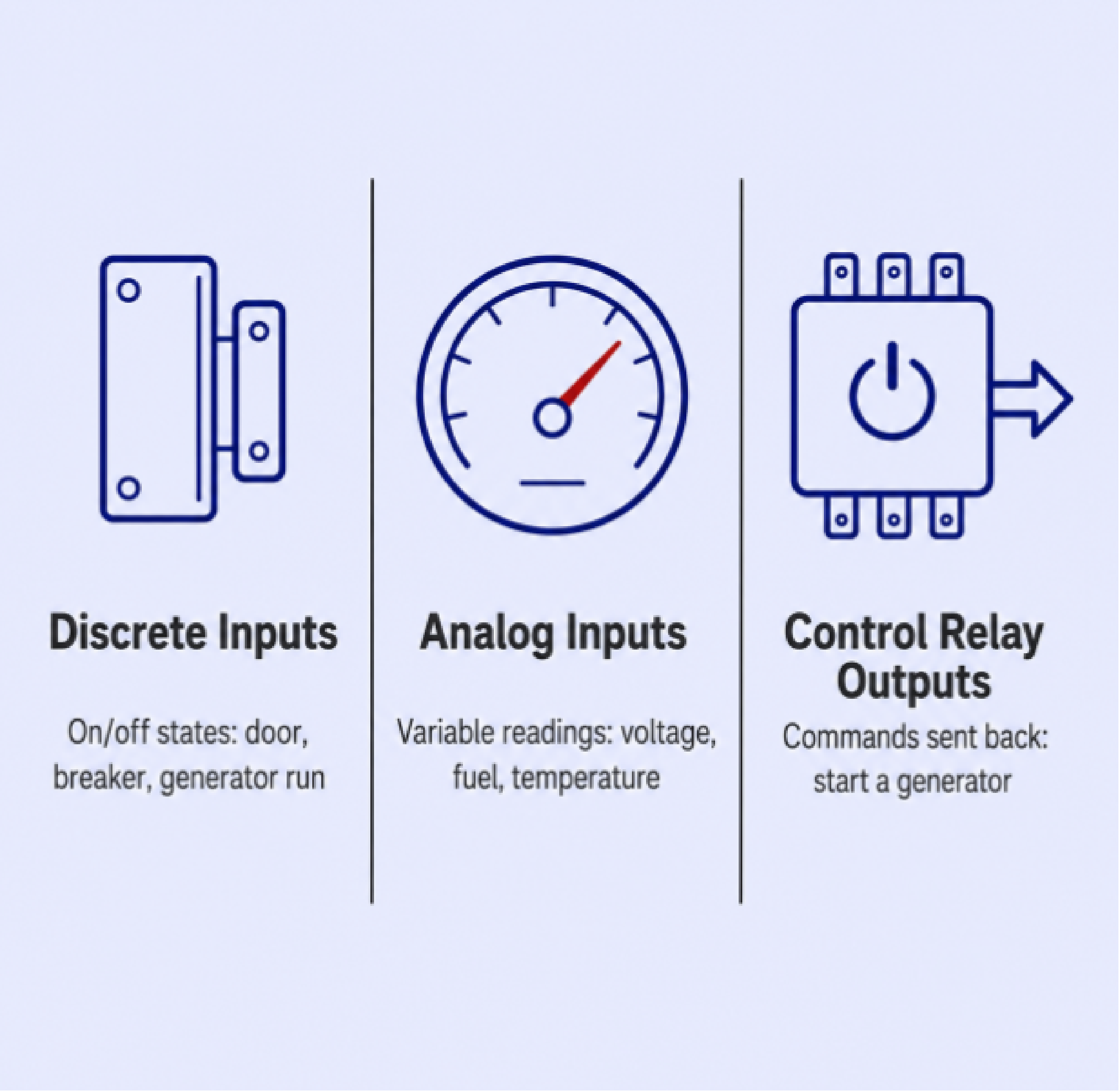
Count what's physically at the site for each of the three types, then add roughly 15% for future growth. That's usually enough headroom to absorb a few new sensors without paying for capacity you'll never use. One caveat for 2026: if your sites fall under a formal design standard, size to whichever number is stricter. A lot of municipal water and wastewater standards, for example, call for 20% to 25% spare input/output (I/O) capacity plus extra physical space in the cabinet, which is more conservative than the common 15% rule of thumb. Our NetGuardian RTUs are configured to the count you actually have, rather than forced into a fixed box, so the capacity matches the site instead of the catalog.
The best RTU is the one that rides the transport already present at each site, instead of one that forces you to rebuild the network to suit the hardware. Sites differ, so your transport mix usually does too: local area network (LAN) or fiber at staffed facilities, cellular at distributed assets, satellite at the isolated ones, and serial, T1, or dial-up at older sites. A unit that supports the widest range lets you standardize on one product family while still matching each location. Our NetGuardian RTUs support Ethernet, fiber, cellular, satellite, serial, T1, and dial-up, which is the broadest transport range in the industry.
Transport rose in weight this year because of the copper sunset. In March 2026, the Federal Communications Commission (FCC) cleared a faster path for carriers to retire copper landline networks, and the notice period before a given line shuts down can be as short as 90 days. Plenty of remote monitoring still rides those copper and dial-up connections, along with fire alarm dialers and elevator emergency phones, so a shutdown notice can turn into a scramble. If you have sites on copper, T1, dial-up, or any number of other older connections, the practical move is to pick a unit that can ride them today while you plan the migration to a modern path. Gear that's reaching the end of its supported life is one of the most common reasons clients come to us for a drop-in RTU replacement.
Here's how the transport options you're most likely to weigh in 2026 stack up.
| Transport | 2026 status | Typical latency | Best fit |
|---|---|---|---|
| Copper landline / dial-up | Retiring under FCC order | High and variable | Older sites being migrated off copper |
| Fiber and Ethernet | Standard | Under 10 milliseconds | Staffed facilities and high-density sites |
| Industrial cellular, including 5G RedCap (Reduced Capability) | Expanding | 20 to 50 milliseconds | Distributed assets and remote stations |
| Low Earth Orbit (LEO) satellite | Expanding | 30 to 50 milliseconds | Geographically isolated sites with poor cellular |
Resilience lives in this decision too. A site that matters can justify a primary transport plus a backup, and an RTU that fails over from one path to another (say, from fiber to cellular, or between two cellular carriers) keeps reporting through a link cut instead of going silent.
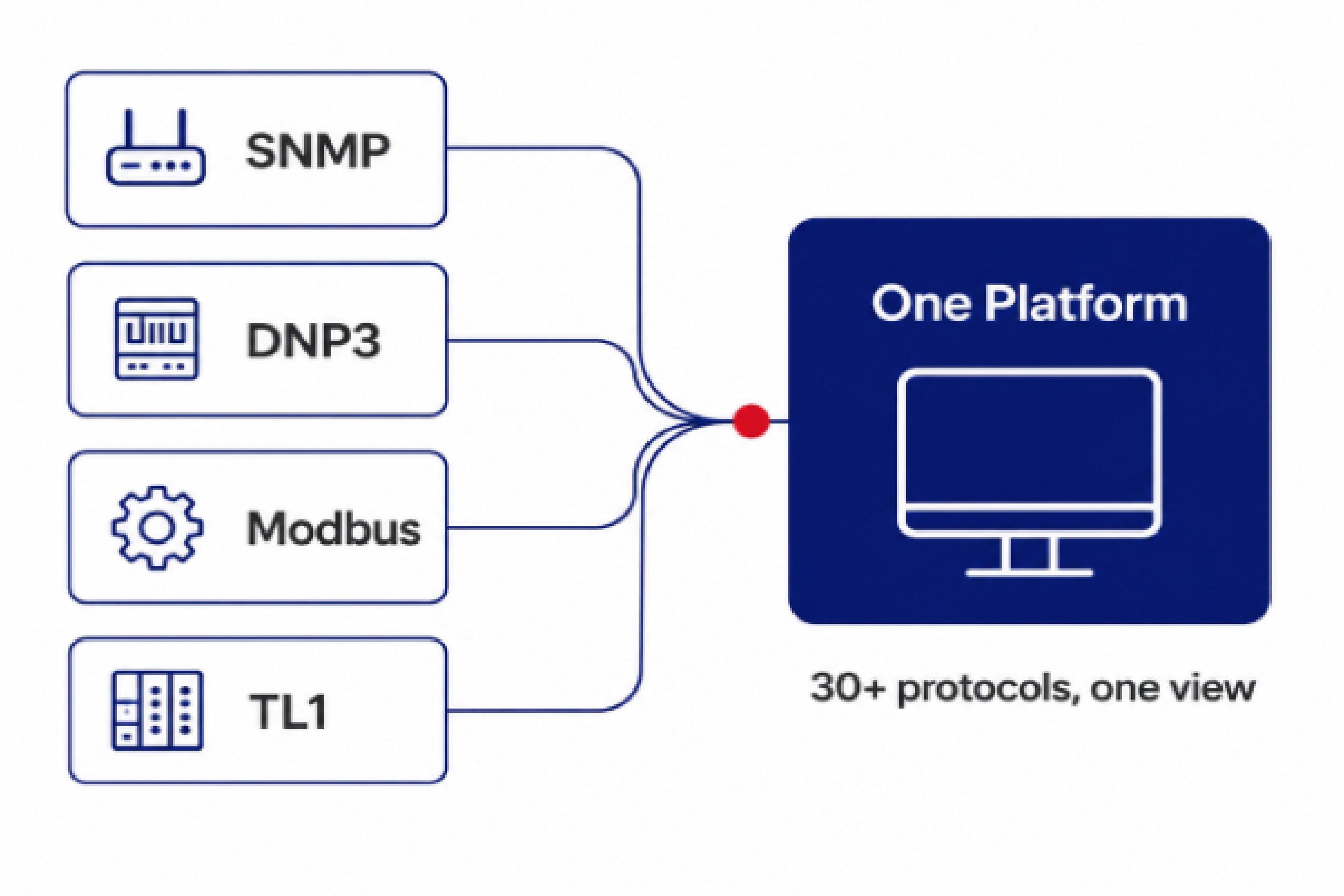
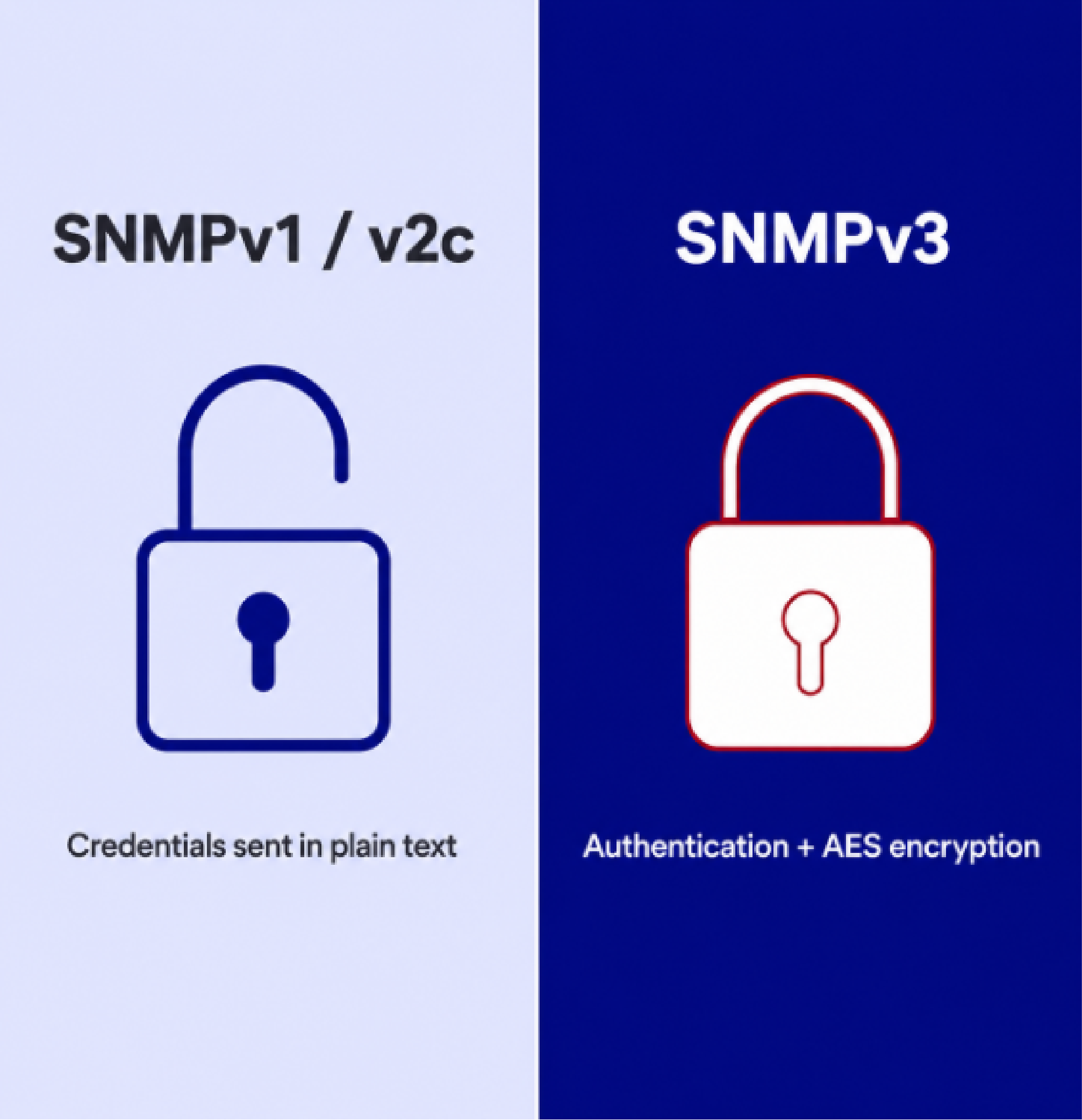
Protocols are the languages your equipment uses to communicate, and the RTU you choose has to speak the same ones your devices do. The common open standards are the Simple Network Management Protocol (SNMP), which dominates telecom, internet service providers, and network operations centers; the Distributed Network Protocol 3 (DNP3), favored in electric power and water systems; and Modbus, the standard for industrial equipment, pipelines, and Heating, Ventilation, and Air Conditioning (HVAC) gear. You may also run into Transaction Language 1 (TL1) on some transport equipment. SNMP itself comes in versions 1, 2c, and 3, and version 3 is the one that adds real security. That matters for the next section.
The trap to avoid is fragmentation, where your monitoring ends up split across several incompatible systems that can't share one view. It usually creeps in when manufacturers use proprietary protocols that only their own equipment speaks, and running those separate systems side by side gets expensive and confusing to manage. The better approach is to pick equipment that brings everything into one view. Our equipment mediates legacy and proprietary gear into standard protocols, and our T/Mon master station now supports more than 30 protocols, each one added because a client needed it. One platform can watch equipment from many different manufacturers, regardless of brand or age.
A pattern worth knowing for 2026 is the protocol-only RTU, a unit that handles protocol translation without any physical monitoring points of its own. We're seeing clients who don't want discrete, analog, or control points at all. They just need to bring in, say, Modbus from a generator or SNMP from a server, then forward an alert or pipe the data into another system. We strip those builds down to cut hardware cost for that one dedicated job. If your need is purely to translate one protocol into another, our SNMP conversion and protocol mediation options cover it without paying for I/O you'll never wire. On bandwidth-constrained cellular or satellite links, a report-by-exception approach (sending data only when something changes) keeps your data usage low while preserving fast alarm visibility.
Remote sites are punishing places for electronics. Outdoor shelters, roadside cabinets, electrical substations, and pumping stations expose hardware to heat, cold, dust, vibration, and electrical surges that cause standard commercial-grade electronics to fail quickly. For critical infrastructure, the benchmark to look for is the Network Equipment-Building System (NEBS), the carrier-grade resilience standard used across U.S. telecom and utility networks. Its two main test suites cover physical survivability (fire, heat, humidity, vibration, and seismic resistance) and electrical behavior (grounding, electrostatic discharge, electromagnetic compatibility, and resistance to high-energy surges and lightning). NEBS Level 3 is the highest tier, and it signals that a unit passed the full suite.
In practice, NEBS-grade hardware shows a few physical traits worth confirming on any RTU you're considering:
We design our RTUs for exactly these conditions, and we run NEBS compliance testing in-house at our Fresno facility, alongside wide-voltage and surge testing. If you want the longer rationale for why this matters, our 10 reasons to consider NEBS-compliant equipment walks through it.
Cybersecurity is the newest factor reshaping how RTUs are chosen in 2026. As information technology (IT) and operational technology (OT) have converged, remote monitoring devices have turned into targets. In 2026, a joint advisory from the Cybersecurity and Infrastructure Security Agency (CISA) and other federal partners confirmed that state-sponsored actors had targeted internet-facing programmable logic controllers (PLCs) and similar operational technology at U.S. water and energy facilities. RTUs sit in that same exposed category, so the old assumption that a device is safe because it sits at a remote site doesn't hold anymore.
When you evaluate an RTU for security, look for these capabilities and practices:
A point buyers sometimes miss is that security depends on how the unit is configured and how the network is segmented, not on the box alone. The most secure RTU on a flat, internet-exposed network is still exposed. Power utilities operating on the bulk electric system have to meet North American Electric Reliability Corporation Critical Infrastructure Protection (NERC CIP) requirements, which call for encrypted transport, disabled unused ports, and remote access that terminates at a jump host. We built our current G6 platform to support encrypted, authenticated access, and we've written up how one utility approached its NERC CIP compliance on the G6 platform. For a broader checklist, our guide on upgrading monitoring to current security standards covers the steps in order.
Two RTUs with similar spec sheets can behave very differently in the field, and the difference often traces back to who built the unit and who answers when you call. Before you commit, ask where the hardware is engineered and built, what testing the maker actually performs, and whether support means direct access to engineers or a script-reading call center. A long track record is a fair proxy for reliability, because hardware that has survived 20 years in the field has already proven what a datasheet only claims.
This is where our model is built to help. Every DPS product is designed, built, and tested at our Fresno, California facility, and our vertical integration means we control the design, the circuit boards, the firmware, and the testing under one roof. We run units through temperature, electromagnetic interference (EMI), and under-voltage and over-voltage testing before they ship. When you need help, you reach the engineers who designed your equipment, backed by 24/7 emergency support plus free lifetime technical support and training. Because we build to last instead of to a replacement cycle, plenty of our original clients from the 1980s are still running DPS equipment today.
The most common procurement mistake is judging an RTU on its sticker price instead of its total cost of ownership (TCO) across a 15 to 20 year life. Industry pricing generally falls into a few tiers:
Saving a couple thousand dollars per site looks attractive until you price the downstream consequences. A consumer-grade unit can fail within a few years under thermal stress, while hardened hardware often runs 20 years or more. Each failure can mean a truck roll, which industry estimates put anywhere from about $150 to as much as $1,000 once you factor in overhead and specialized labor. The bigger number is the outage you fail to catch. Industry estimates put one hour of utility downtime at roughly $300,000 on average, and according to Oak Ridge National Laboratory, major power outages cost U.S. electricity customers about $121 billion in 2024. A single prevented outage can pay for hardened hardware many times over.

The table below shows the lifecycle math. The figures are industry estimates meant to show the pattern, not a quote for any specific product.
| Cost element | Consumer-grade unit (about $200) | Hardened industrial unit (about $2,500) |
|---|---|---|
| Upfront price | About $200 | About $2,500 |
| Field life | 2 to 5 years | 15 to 20+ years |
| Technical support | Little to none | Lifetime, direct to engineers |
| Firmware updates | None or paid | Free for the life of the unit |
| Truck rolls | Higher, from failures and false alarms | Near zero, with remote diagnostics |
Our position is to compete on value and lifecycle, not on the lowest upfront price. Free lifetime support and training, no surprise fees, and a 20-plus-year service life change the real math in your favor.
If you've rolled out hardware across remote sites before, you know a datasheet only tells you so much. Experienced buyers don't commit to a wide rollout on the strength of one. They run a small, representative trial in their own environment first, because that's the only way to confirm the unit behaves the way the spec sheet promises. A good trial answers four questions:
How buyers de-risk this varies, but the strongest options are a hands-on evaluation unit, a loaner agreement that uses a memorandum of understanding (MOU) instead of an upfront purchase order, and a money-back guarantee. We offer all three: a 30-day loaner program so you can run our equipment in your environment risk-free, a money-back guarantee, and a no-risk consultation with our application engineers. If you want a structured way to run the evaluation, our guide to evaluating an RTU lays out the steps.
A remote telemetry unit (RTU) is built for monitoring over long distances, with slow scan rates, built-in cellular or satellite communication, and store-and-forward to survive intermittent links. A programmable logic controller (PLC) is built for high-speed local machine control with millisecond scan rates, so it's the better choice for fast, safety-critical automation at a single location.
Count the discrete, analog, and control points currently at the site, then add roughly 15% headroom for growth. If a formal design standard applies to your sites, size to its stricter spare-capacity requirement instead.
Yes. Through protocol mediation, an RTU or master station can bring SNMP, DNP3, Modbus, and proprietary equipment into one platform regardless of brand or age.
If you have more than a handful of remote sites, a master station like T/Mon consolidates every RTU onto one screen, so you're not logging into each unit separately to see what's happening.
Every network is different, which is why we start by understanding your sites, your transport, and the equipment you need to watch, then design a unit that fits instead of selling you a fixed box. We've done this for more than 1,500 companies, and we're glad to walk through your specific situation, set you up with a risk-free loaner, or just answer questions before you decide. Tell us what you're trying to accomplish, and we'll help you figure out the right fit.
Talk to an Engineer | 800-693-0351

Andrew Erickson
Andrew Erickson is an Application Engineer at DPS Telecom, a manufacturer of semi-custom remote alarm monitoring systems based in Fresno, California. Andrew brings more than 19 years of experience building site monitoring solutions, developing intuitive user interfaces and documentation, and opt...