Check out our White Paper Series!
A complete library of helpful advice and survival guides for every aspect of system monitoring and control.
1-800-693-0351
Have a specific question? Ask our team of expert engineers and get a specific answer!
Sign up for the next DPS Factory Training!
Whether you're new to our equipment or you've used it for years, DPS factory training is the best way to get more from your monitoring.
Reserve Your Seat TodayFiber networks fail silently. A hut overheats, a battery goes flat, a door gets left open at an unmanned POP, and the first sign of trouble is a client call, not an alert from your NOC. DPS Telecom builds the RTUs and alarm management systems that give fiber operators continuous, remote visibility into every site on their network.
We've deployed monitoring solutions for ISPs, rural telcos, fiber cooperatives, and major carriers across more than 1,500 organizations since 1986.
Talk to an Engineer | 800-693-0351
A fiber network monitoring system collects alarms and sensor data from remote sites: fiber huts, POPs, nodes, headends, and equipment shelters, then reports everything to a central location in real time.
It has two core components:
At DPS Telecom, our NetGuardian RTUs handle the site-level collection. Our T/Mon LNX alarm manager handles centralized monitoring across all sites.
Most fiber network failures don't start with the fiber itself. They start at unmanned huts, POPs, and nodes where the supporting infrastructure fails undetected. Fiber transport equipment is also only as reliable as the environment it lives in, and the equipment itself rarely reports environmental conditions. That's the gap a dedicated RTU is built to fill.
The most common failure points at fiber sites are:
For fiber huts and POPs in particular, temperature is the highest-risk factor. If you're not monitoring it, you won't know there's a problem until gear starts failing.
The monitoring points that catch these failures fall into a handful of categories:
| Category | What We Monitor |
|---|---|
| Environmental | Temperature, humidity, water intrusion, smoke |
| Power | AC voltage, battery voltage, rectifier status, generator run status and oil pressure |
| Site Security | Door contacts, motion sensors, access control |
| Transport | Link status, equipment alarms via contact closure or SNMP |
| HVAC Monitoring | Cooling unit status, airflow |
Our D-Wire sensors cover the full range of environmental monitoring needs at fiber sites: temperature, humidity, water detection, smoke, and airflow. Sensors connect via industry-standard 0-5VDC or 4-20mA interfaces, compatible with all NetGuardian RTUs. Our guide to environmental alarm monitoring for remote sites covers how to build out a complete sensor strategy, and the same principles apply to equipment shelter monitoring at fiber infrastructure sites.
Talk to an Engineer | 800-693-0351
Our NetGuardian RTU family covers the range of site sizes typical in fiber networks, from large central offices to small unmanned huts.
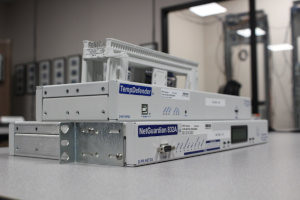
NetGuardian 832A G6: The full-featured option for larger sites with many discrete alarms, analog inputs, and control relays. Supports SNMP, TL1, Modbus, DNP3, and more.
NetGuardian 216: A compact RTU commonly deployed in fiber transport applications. Well-suited for smaller sites and fiber nodes.
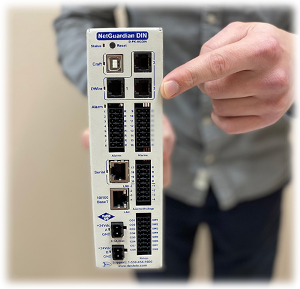
NetGuardian DIN: Rail-mounted form factor for tight cabinet installations.
TempDefender G2: Purpose-built environmental monitoring for sites where temperature and humidity are the primary concern.
All NetGuardian units support Ethernet connectivity, and can also communicate via T1, serial, fiber, cellular (GSM/CDMA via external gateway), satellite (via external gateway), or dialup. This matters when a remote fiber hut doesn't yet have a reliable IP backhaul.
Rural telcos and fiber-to-the-home (FTTH) operators in particular tell us this transport flexibility is what lets them monitor sites that other vendors can't reach. When a hut sits hours away from the nearest tech and has no Ethernet drop, a cellular or satellite-backed RTU is the difference between visibility and a blind spot. See how rural telco remote monitoring applies to fiber-heavy networks.
If you're managing more than a handful of sites, logging into each RTU individually isn't practical. The T/Mon LNX alarm master aggregates alarms from all your RTUs into a single interface.
Key capabilities:
Fiber networks frequently include equipment from multiple vendors, some of it proprietary hardware that predates modern SNMP. NetGuardian remote telemetry units report via SNMP (v1, v2c, v3), which integrates with most existing NMS platforms. T/Mon adds support for 30+ additional protocols, so older equipment that speaks TL1, Modbus, or any number of other proprietary formats can be brought under the same monitoring umbrella as newer SNMP devices.
T/Mon is also compatible with third-party management systems if you're already using an SNMP manager for your IT infrastructure. We commonly see it working alongside enterprise platforms to handle the OT/telecom monitoring layer. Learn more about multiprotocol alarm monitoring for mixed-equipment environments.
If you need a protocol we don't yet support, we've added new protocols at client request throughout our history. Tell us what you're working with, and we'll evaluate support options.
Talk to an Engineer | 800-693-0351
DPS Telecom has been designing and manufacturing remote monitoring equipment in Fresno, California since 1986. We've shipped more than 172,000 devices to over 1,500 organizations, including major carriers, rural telecom cooperatives, ISPs, and utilities.
A few things that matter specifically for fiber networks:
We've handled fiber network monitoring case studies across a range of network types and sizes. If your situation is similar to something we've solved before, we'll tell you.
A complete fiber network monitoring deployment comes together in a predictable sequence. NetGuardian RTUs go in at each fiber hut, POP, node, and headend to collect environmental, power, security, and equipment alarms from the gear at that site. Those RTUs report back to T/Mon LNX at your NOC, which aggregates everything onto a single map view, drives notifications, and keeps a full audit trail.
The result is what fiber operators tell us they actually want: knowing about a problem at an unmanned site before it becomes a client-affecting outage, and knowing exactly what's wrong before dispatching a technician.
Standard hardware ships in weeks. Custom builds are typically ready for field trial within two months.
A fiber network monitoring system uses RTUs at remote sites to collect alarms and environmental data, then reports that information to a central management platform in real time.
The most common monitoring points are temperature, humidity, power (AC, battery, and generator), door access, and equipment alarm contacts.
Yes. NetGuardian RTUs support Ethernet, T1, serial, fiber, cellular, satellite, and dialup connectivity, which is useful for fiber sites that lack reliable IP backhaul.
Yes. NetGuardian RTUs report via SNMP and integrate with most standard NMS platforms. T/Mon LNX also supports 30+ protocols for mixed-equipment environments.
Standard hardware typically ships within weeks. Custom configurations are generally ready for field trial within two months of finalizing specifications.
Every fiber network has its own mix of site sizes, equipment vendors, transport options, and gaps in visibility. Tell us what you're working with, what's already deployed, and where the blind spots are. Our engineers will walk through your sites with you and recommend a configuration that fits.
No sales pressure, no scripted call center, no off-the-shelf assumptions. You'll talk to an engineer who has worked on networks like yours, and you'll leave the conversation with a concrete recommendation, whether or not you decide to buy from us.